After Abdominal Surgery, Her Neighbor Changed the Dressings
Elena had no nearby relatives after abdominal surgery. Her neighbor handled the dressings, the phone calls, and the parts of discharge planning filed loosely under family.
 Rosa DelgadoNarrator, Caregivers
August 28, 2026 · 7 min read

The notebook appeared before the surgery.
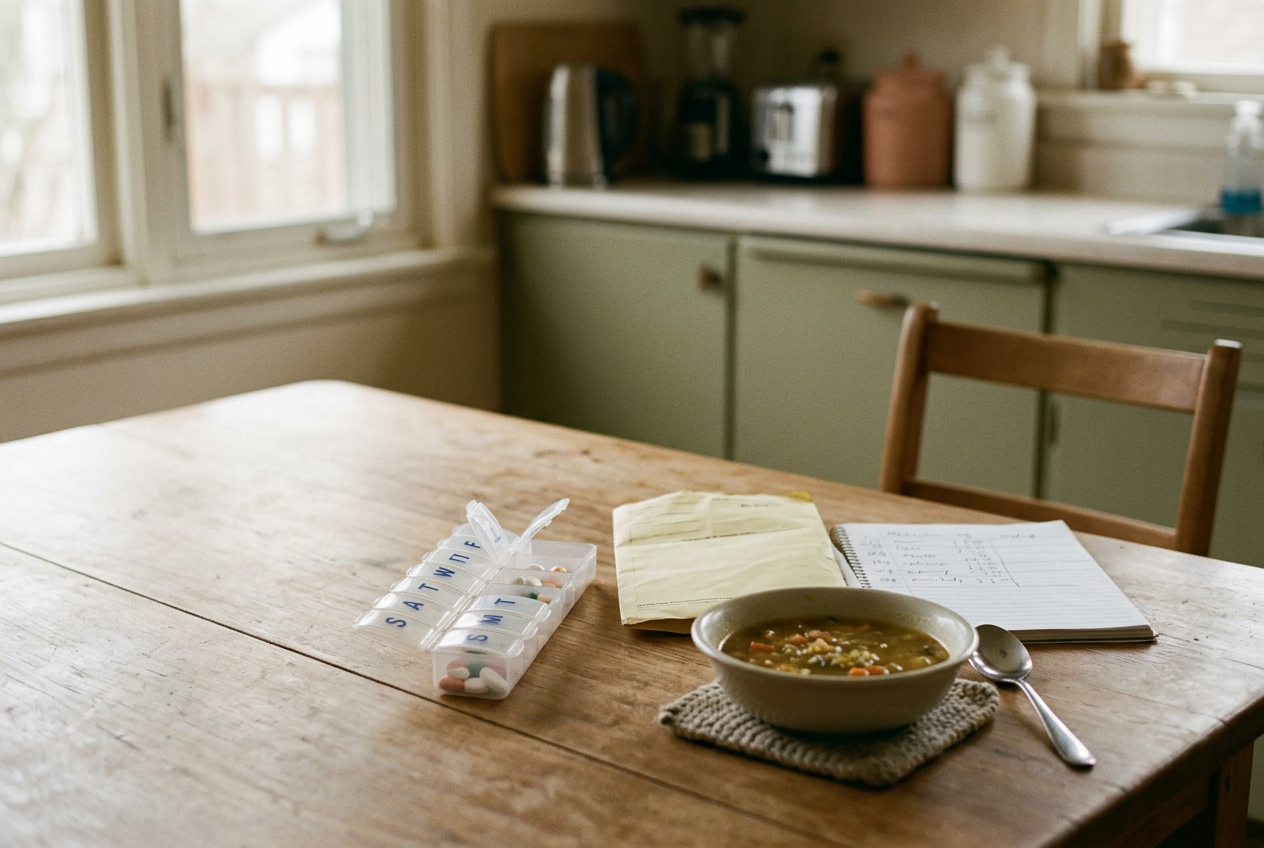
Elena, who was in her seventies and lived alone, put it on her kitchen table beside a pen and the envelope of hospital papers. She had bought it to track what needed doing after abdominal surgery. At first, the pages held transportation details, a grocery reminder, and the names of people she expected to call. Most lived several states away.
Ruth lived in a nearby apartment. The women had known each other for nine years, long enough to exchange keys and notice when the other's mail had not been picked up. Ruth had driven Elena to appointments before. She had also carried in groceries during a winter respiratory illness, which was how she had learned that Elena considered canned soup a complete emergency plan.
Four days before the operation, Elena asked whether Ruth could drive her home and check on her afterward. Ruth agreed. She pictured reheating food and making sure the phone stayed charged.
At the hospital, that modest favor expanded.
A nurse reviewing the discharge plan asked who would be with Elena at home. Ruth's name went into the chart after Elena gave permission for staff to speak with her, and the conversation moved toward dressing supplies, follow-up appointments, and what the hospital expected another person to notice. The instructions were not framed as an invitation to become a caregiver. They arrived as the next part of leaving.
Elena was tired and uncomfortable, with an envelope on her lap and a ride waiting. Ruth listened while a nurse demonstrated how the dressing would be handled, then placed packets of gauze and tape into a bag. There was no test of whether Ruth felt able to do this. Nobody asked whether her hands shook, whether blood made her faint, or whether she had work the next morning.
The plan had found its family member. The fact that Ruth was not one did not slow it down.
The blank after family
Elena's closest relatives cared about her. One called most evenings. Another offered to pay for food delivery. Neither could travel during the first nineteen days, and affection, however real, could not stand at a kitchen sink or carry a bag of used dressing material to the trash.
Ruth arrived the morning after discharge with her apartment keys in one pocket and the notebook under her arm. Elena had slept in brief stretches. The hospital papers were on the table, mixed with unopened mail and a takeout menu. Apparently even abdominal surgery generates recycling.
For nineteen days, Ruth dated a page whenever she helped with the dressing. She noted whether they had enough supplies and whether Elena had called the doctor's office. The entries were not clinical records. They were short reminders written by someone who worried that exhaustion would make both women misremember what had happened.
The notebook also held the less official work. Ruth wrote down that the laundry needed moving before Elena tried to lift the basket herself. She added milk to a grocery list. After a follow-up visit was rescheduled, she crossed out the old month and wrote in the new one, pressing hard enough to mark the next page.
A discharge planner had briefly raised the possibility of home health support, but coverage depended on the insurer's rules, a clinician's assessment, and whether an agency could accept the referral. By the time Elena went home, no visit had been arranged. Ruth understood that someone might still call. She also understood that the dressing could not wait for an administrative answer.
This was the quiet bargain: Elena would let Ruth see her frightened and partly undressed, while Ruth would behave as though the arrangement was ordinary enough to protect them both from embarrassment.
It was intimate work without the language people use for intimate relationships. Ruth was not a spouse, daughter, or paid aide. She was the neighbor who knew where Elena kept the clean towels and which burner on the stove took an extra turn to light, details that mattered more in those weeks than a family tree.
What the notebook could not authorize
About a week after discharge, the dressing looked different from what Ruth remembered seeing at the hospital. She did not try to interpret it. She called the specialist's office with Elena sitting beside her.
The office needed Elena's permission before discussing anything with Ruth. That was reasonable, but it meant Elena had to take the phone while tired, confirm that Ruth could speak, then hand it back. A message went to the clinical staff. Later, the office asked Elena to send information through the patient portal, which Ruth helped her open because the password was stored on a piece of paper in another room.
The notebook tracked the call and the response. It could not make Ruth an authorized representative everywhere Elena received care, and it did not answer the larger question of what would have happened if Ruth had been unavailable that afternoon.
Hospital discharge planning often includes a broad instruction to have someone help at home, which can sound sensible until the word someone has to become a person with transportation, free time, access to the apartment, and enough trust to assist with a wound. Family is often treated as an existing service. No one bills for it, schedules it, or checks whether it has staff.
Ruth had a part-time office job. During the first week, she traded shifts and kept her phone volume high, though Elena rarely called between visits because she did not want to become a nuisance. This created a familiar and inefficient arrangement in which one woman tried not to ask for help while the other kept checking whether help was needed.
Ruth resented the assumption that she would keep being available, especially after a difficult evening when Elena snapped at her over a bag placed on the wrong counter. She also loved Elena and returned the next morning with groceries. Those facts occupied the same kitchen. They did not cancel each other out.
There were limits. Ruth would not make medical decisions. She would not promise Elena that everything looked fine. When a concern fell outside what the hospital had demonstrated, they contacted the doctor's office or raised it at follow-up.
That distinction mattered to Ruth, though it did not make the responsibility feel light.
After nineteen days, the specialist changed the wound-care plan during a follow-up visit. Ruth wrote the update in the notebook without copying medical language she did not understand. The regular dressing help ended, but the caregiving did not disappear on schedule. For another six weeks, Ruth carried groceries, took out trash, and drove Elena to appointments when she could.
Elena's relatives thanked her. One sent money for gas, which Ruth initially refused and later accepted. The amount was less important than the acknowledgment that her time had been spent, although nobody could return the sleep she had lost or the work shifts she had rearranged.
Chosen family is often praised for its devotion. Less gets said about its paperwork. Ruth could be trusted with an apartment key and a private view of Elena's recovery, yet each new office had its own process for allowing her into the conversation. Elena had to be awake, present, and able to repeat that this neighbor belonged there.
Three months after surgery, the notebook was still on the kitchen table. Most of its later pages were blank. Elena used one to write down the cost of groceries Ruth had picked up, then tucked cash between the pages even though Ruth had told her not to.
Ruth took the cash. She left the notebook.
Questions people ask
Can a neighbor help with wound care after surgery?
In this story, the hospital included Ruth in the discharge teaching after Elena gave permission, and Ruth stayed within what staff had demonstrated. What a neighbor can take on depends on the patient's needs, the discharge plan, and the neighbor's willingness. Being trusted does not automatically make someone trained, available, or authorized to speak with every office.
What happens when a patient has no nearby family?
A hospital discharge team may discuss home health services, transportation, or other support, but availability and insurance coverage vary. Elena's experience showed the practical gap: a referral was possible, yet no visit had been arranged when she left. The plan still depended on a real person being present, and Ruth became that person by default.
Does insurance cover home health after surgery?
Coverage can depend on the health plan, the clinician's assessment, and whether the requested service meets the insurer's requirements. Even when coverage is possible, an agency may not be available when the patient goes home. In Elena's case, uncertainty about a future visit did not replace the help she needed during the first days.
Can chosen family speak with the medical team?
Patients can often give permission for a trusted person to join conversations, though each office may handle that permission differently. Elena repeatedly confirmed that staff could speak with Ruth. The notebook recorded the calls but carried no legal authority; by the third month, it held a grocery total, folded cash, and Ruth's pen.
One story a day
The story of the day, in your inbox
One health journey each morning — no advice, no alarm, just company for the road.