Her Two Mothers Used One Notebook After Gender-Affirming Surgery
Former spouses with different tolerances for postoperative care divided a long drive, wound concerns, and hospital calls without taking control away from their adult daughter.
 Rosa DelgadoNarrator, Caregivers
September 5, 2026 · 7 min read

Leah was 27 when she scheduled gender-affirming surgery more than 400 miles from home. Her mothers, Marisol and Beth, had been divorced for 12 years and had not taken a trip together since Leah was in middle school.
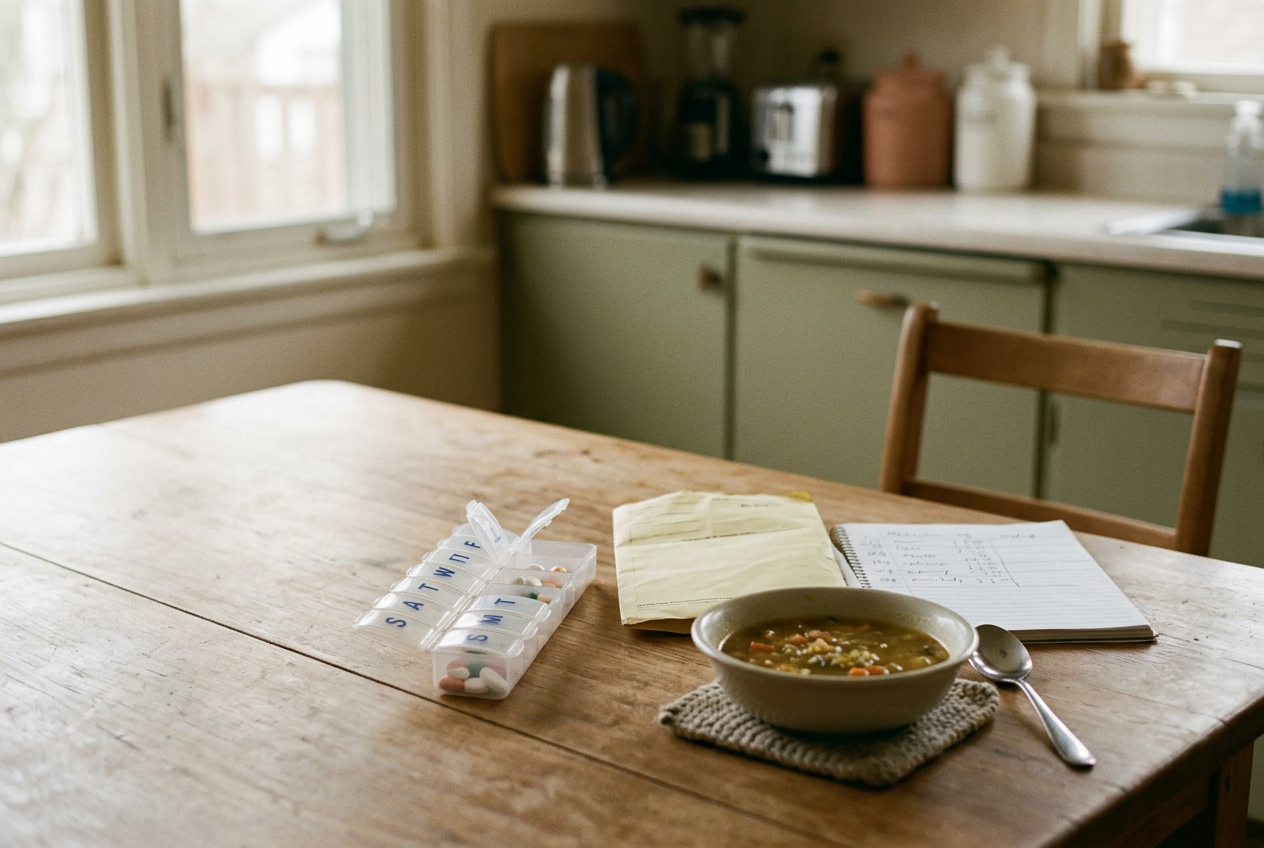
Leah bought a notebook before they left. She put it on the kitchen counter during their first planning dinner, beside the car keys and a grocery receipt, then wrote down the rental address and the dates they would be away. At the top of the next page, she recorded the rule that mattered most: she would decide who helped with intimate care and what information either mother could share.
The notebook was not a family diary. It held travel expenses, questions for the surgical team, and brief descriptions of anything Leah wanted tracked. It did not hold her dilation details, photographs, or either mother’s opinions about her body.
That boundary looked easy on paper.
Two kinds of useful
Marisol was comfortable around dressings and drainage. She had cared for her own father after an operation and could listen to postoperative instructions without her mind wandering toward every possible emergency. Beth became lightheaded around blood and disliked touching anything that came in sealed medical packaging, even when the package contained something as ordinary as gauze.
Beth, however, could stay on hold with an insurance company without surrendering her afternoon or her temper. She kept the rental receipts, checked what the travel coverage would reimburse, and called the surgical office when instructions in the patient portal seemed to conflict with something they had heard before discharge.
Leah assigned them jobs according to those differences. Marisol would help when Leah requested hands-on care. Beth would handle driving, food, and calls, while both mothers attended the caregiver teaching because Leah did not want essential information stored in one person’s head.
Neither mother loved the arrangement as much as she claimed.
Marisol thought Beth got the cleaner work, which included asking organized questions while someone else carried used dressings to the trash. Beth felt Marisol treated her fear of wound care as a character defect. Each loved Leah enough to show up, and each resented being placed back beside a former spouse who still knew how to make a raised eyebrow feel like a full paragraph.
Leah did not ask them to repair their marriage after the fact. She asked them to keep the rental kitchen usable and direct disagreements away from her bed.
The surgery was followed by several nights near the hospital and another stretch in a furnished rental. The apartment cost $1,972 for 17 nights, an amount Beth copied into the notebook and underlined once. They had budgeted for lodging, but not for parking, grocery deliveries, or replacing the pillow Leah found uncomfortable after the first night.
Those expenses mattered. So did the single bathroom.
The person recovering remained in charge
After discharge, Leah tired faster than either mother expected. Instructions that had sounded manageable in the hospital became harder to hold onto once everyone was hungry, the phone needed charging, and a bag of supplies had been placed in a closet rather than on the counter where Marisol thought she had left it.
Leah chose which mother came into the bedroom when she needed assistance. Sometimes she wanted Marisol because Marisol’s hands did not shake. At other points, she wanted Beth, who moved more slowly and waited to be told what to touch. There were also periods when she wanted the door shut and both of them elsewhere.
The privacy around dilation was firm. Leah’s postoperative plan included it, but she did not want either mother monitoring whether it happened or recording details. Beth initially argued that caregivers could not be responsible for recovery while being denied information. Leah said responsibility did not grant access to everything.
Marisol agreed with Leah, partly from conviction and partly because disagreeing with Beth still came easily. Later, while washing two mugs at the rental sink, she admitted that she also wanted reassurance and was having to live without it.
They changed the notebook. Instead of documenting private care, they left a line for anything Leah wanted raised with the surgical team and another for practical matters such as meals or prescription pickups. Leah could write in it herself, dictate an entry, or leave the page empty.
The empty pages counted too.
Five days after discharge, Leah became concerned about a change near the surgical area. Marisol thought they should return to the hospital. Beth wanted to call first, partly because the drive was difficult for Leah and partly because Beth feared Marisol’s alarm would become the only fact anyone heard.
Leah chose the call.
Beth used the number provided by the surgical team and described what Leah had authorized her to describe. Marisol sat beside the notebook, supplying the duration of the change and reading back a prior entry so they did not rely on exhausted memory. The clinical staff arranged an evaluation and told them what information to bring.
The concern was assessed without the mothers having to decide for themselves what it meant. Back at the rental, Beth added a short entry about the visit. Marisol crossed out a sentence that sounded more certain than the clinician had been.
That small correction prevented a larger fight. It also irritated Beth for the rest of the evening.
The drive home
The return trip took more than seven hours once they included stops. Leah rode reclined in the back while her mothers exchanged driving duties, though Marisol disliked Beth’s route and Beth disliked being given directions from someone who was no longer navigating.
Before leaving, Leah had decided that neither mother would move into her apartment. Marisol would stay nearby for the first four nights, sleeping at a short-term rental, and Beth would take the next four. After that, Leah wanted help by request rather than a standing audience.
Her mothers had imagined a longer rotation. They had calendars. Beth had moved work obligations. Marisol had packed enough clothing for three weeks.
Leah’s plan made them feel unnecessary at the moment when their concern was loudest, but the operation had happened to her, and she did not owe them extra dependence to make their preparation feel worthwhile.
At home, the notebook moved to Leah’s kitchen table. The entries became less medical. Beth wrote down $86 for groceries and left the receipt between two pages. Marisol noted that the laundry was finished.
Leah removed a page containing a description she no longer wanted kept, and neither mother asked where she put it.
The hardest handoff came after eight days, when Beth returned Leah’s apartment key to the dish by the door. Marisol believed Leah still needed daily support. Beth thought she was ready for more privacy. Leah wanted both mothers to stop discussing her recovery as if she were in another room, particularly when she was sitting between them.
They stopped. Not forever, and not gracefully.
Over the following month, Leah used the notebook less often. When she contacted the surgical team, she sometimes did it without involving either mother. Marisol found this reassuring. Beth found it alarming.
Their positions had switched, which nobody mentioned.
Questions people ask
Can two former spouses share postoperative caregiving?
They can divide responsibilities without pretending they have identical skills or a repaired relationship. In this family, both mothers learned the discharge information, while one handled most hands-on care and the other managed transportation and calls. Their daughter decided when that division changed.
How can caregivers respect privacy after gender-affirming surgery?
Leah identified which details could be recorded and which remained private, including parts of her intimate postoperative routine. Her mothers still had enough information to help with approved tasks and communicate concerns, but caregiving did not give them unrestricted access to her body or medical information.
What happens when caregivers disagree about a wound concern?
Marisol and Beth recorded the change their daughter noticed, then contacted the surgical team with her permission rather than settling the medical meaning themselves. The notebook helped them describe duration and prior events without turning one mother’s fear or the other mother’s caution into a conclusion.
How do families manage recovery far from the hospital?
For this family, distance affected lodging costs, the return drive, and how long each mother could stay away from work. Their plan changed as Leah recovered and asked for more privacy. The notebook’s final page held the $1,972 rental total, two crossed-out grocery items, and the date each mother went home.
One story a day
The story of the day, in your inbox
One health journey each morning — no advice, no alarm, just company for the road.