Their Son Had Leukemia. His Divorced Parents Shared One Notebook
One parent wrote paragraphs. The other preferred check marks. A $4.79 notebook helped them coordinate their son’s leukemia treatment without retrying the divorce.
 Rosa DelgadoNarrator, Caregivers
August 29, 2026 · 8 min read

The notebook cost $4.79 at a grocery store. Elena wrote SAM on the front, then underneath it: MEDS AND SCHOOL. Marcus later added CHARGERS, because the good phone charger kept disappearing, a family problem leukemia had not cured.
For this composite, I’ll call their son Sam. He was 9 when he was diagnosed with leukemia in April 2022, four years after his parents separated and two years after a divorce that had produced a workable custody schedule but no great improvement in their ability to talk.
Elena worked weekdays in a property management office. She liked full sentences, advance notice, and confirmation that the advance notice had been received. Marcus drove delivery routes that began before daylight, slept in the afternoon when he could, and treated a check mark as a complete communication.
Before Sam got sick, this mismatch mostly affected pickups, missing sweatshirts, and whether a school project had been left at the other house. Treatment raised the stakes. An unread message might now concern a medication already given, a fever reported to the care team, or an appointment changed while one parent was working.
Their first attempt was text messaging. Elena sent context. Marcus answered the final sentence. Marcus sent photographs of discharge pages without saying which part mattered, and Elena enlarged them on her phone while sitting in her car outside work.
They were both frightened. They were also still themselves.
The notebook enters the handoff
Elena bought the notebook six weeks into treatment, after Sam came home from the hospital with several medication containers and instructions that had been reviewed with both parents at different moments. No dose is reproduced here. What mattered to them was knowing whether a prescribed medication had been given, whether Sam had kept it down, and which parent had spoken with the care team.
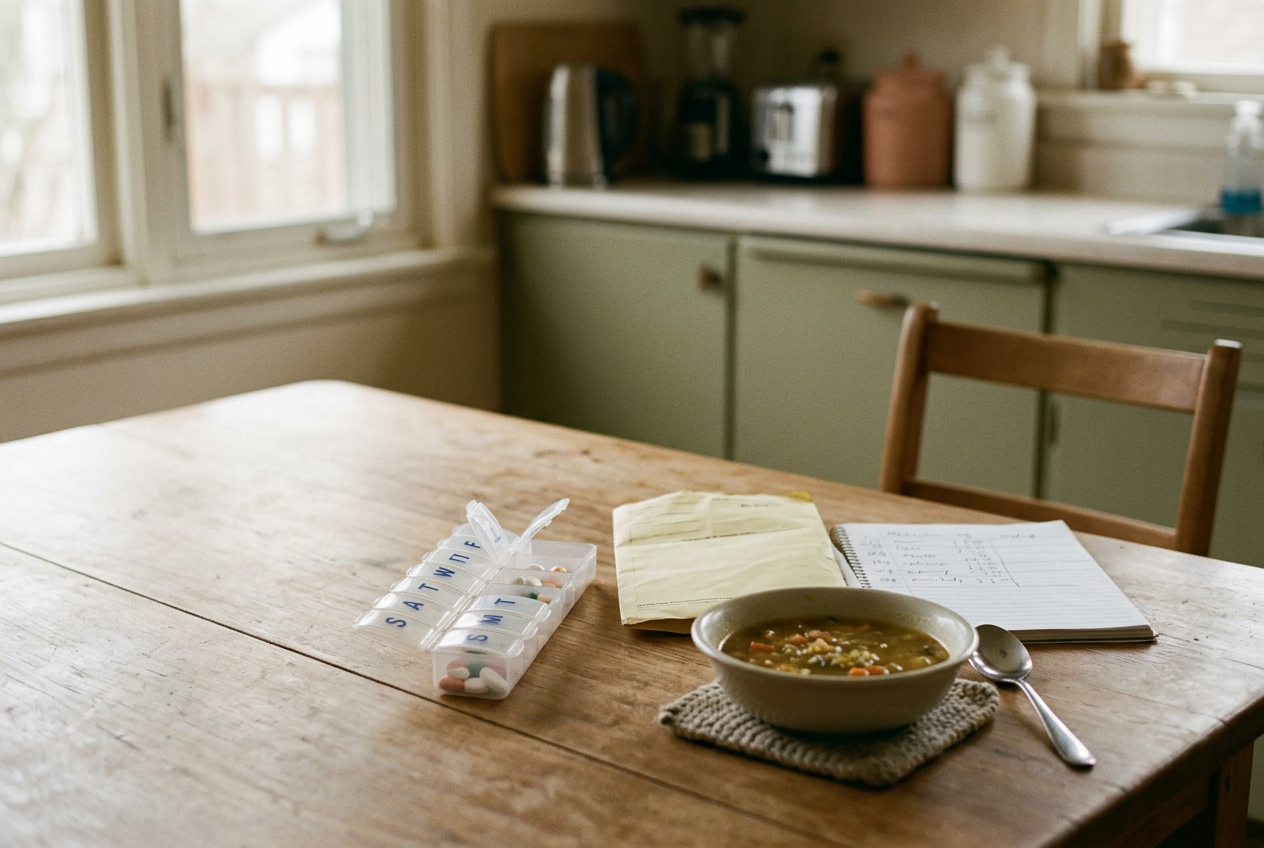
The notebook stayed with Sam’s backpack. Each page covered one day. Elena wrote short notes about symptoms, calls, and schoolwork; Marcus made boxes for morning and evening medications, then initialed them after giving what had been prescribed. Neither method changed the other person’s personality, which may be why the arrangement lasted.
At handoffs, the notebook sat on the kitchen counter while they exchanged the details that could not wait. Sam might be on the couch watching a show, annoyed that adults were discussing his stomach again. One parent packed his sweatshirt while the other checked the backpack for the notebook and the medication bag.
It was not a warm ritual. It worked.
During one early handoff, Elena saw that Marcus had written that Sam felt sick after dinner but had not sent a text. She wanted to tell him that a notebook was not useful if she did not know to look at it. Marcus pointed to the page. The information was there, and the care team had already been contacted.
She resented the way he could make her feel unreasonable while she was trying to protect their child, and she loved that he had stayed beside Sam through the night, listening for movement from the next room. Both facts went into the car with her. Neither was settled.
Hospital nights did not follow the custody calendar
The old schedule stopped making sense during admissions. Sam wanted whichever parent had been with him when the hospital stay began, then sometimes changed his mind after a day. Work leave was limited. Parking and meals added up, even when insurance covered much of the medical care.
They divided hospital stays according to what each could miss at work, not whose custody week it was. Elena often handled weekdays because her supervisor allowed some remote work. Marcus took more overnight stretches and weekends, arriving with a clean shirt for Sam and usually forgetting one for himself.
The notebook stayed on the tray table or inside the backpack. It contained questions they wanted addressed during rounds, notes about what Sam had eaten, and reminders about who had contacted the school. When a specialist explained a change in the treatment plan, the parent in the room wrote a plain summary and added the date by month and year, while the other parent later checked the hospital portal for the clinical version.
This did not prevent arguments. It shortened some of them.
Once, after a three-night admission, Marcus left the hospital believing Sam would return to his house. Elena understood that Sam was coming with her. Their messages became sharp enough that both started pulling examples from the divorce, including one holiday exchange that had nothing to do with leukemia or the current backpack.
Sam interrupted by saying he wanted his own bed, which was at Elena’s house that week. Marcus drove him there. The notebook went too. The holiday argument remained unfinished, probably because it had never been finishable.
School became one shared address
Sam missed long stretches of school during the first fourteen months of treatment. At first, automated absence messages went only to Elena, while assignments sometimes reached Marcus through a separate classroom system. Each assumed the other had received what they had received.
The consequential change was small: the school began copying both parents on one email thread, and the notebook held the name of the current assignment rather than every message about it. Sam’s teacher sent work that could be done in short pieces. Some of it came back completed. Some stayed in the folder until it no longer mattered.
Elena cared more about keeping him connected to his class. Marcus cared more about stopping when Sam was tired. This difference resembled older arguments about homework, except now both could point to fatigue, appointments, and long absences, which gave the disagreement facts without making it easier.
They agreed that the notebook would record what Sam attempted, not why he stopped. That spared him from becoming evidence in a parental dispute.
One page from that winter had a spelling assignment at the top, a note about nausea in the middle, and a reminder at the bottom that Sam needed poster board. Marcus bought the poster board. The project was never finished. It remained behind a dresser for eight months.
The messages got smaller
About ten months into treatment, the text messages changed. Elena stopped sending explanations that began with the history of the problem. Marcus stopped replying with a thumbs-up when the subject required words.
They used texts for changes that affected the next few hours and the notebook for what the next parent needed to know. The portal held test results and visit summaries. If information conflicted, they contacted the care team rather than deciding which parent had misunderstood it.
This sounds orderly. Their kitchens were not orderly, and neither were their emotions.
Elena once found an unsigned medication box in the notebook and called Marcus during his sleep. He had given the prescribed medication but forgotten to mark it. She was angry about the missing check. He was angry that she assumed the worst.
They confirmed what had happened, updated the page, and ended the call without discussing trust, responsibility, or the marriage.
That was progress, though nobody used the word.
Sam eventually began carrying the notebook between houses himself. His parents did not ask him to explain its contents or report on the other household. He was responsible for the backpack, in roughly the same way he had once been responsible for a library book, except both adults checked for it before the car left.
By then the notebook had medication records, school notes, hospital parking receipts, and drawings Sam made while waiting. Elena removed the receipts when the cover began to strain. Marcus taped in a loose page. Sam crossed out CHARGERS on the front after finding the missing one under his bed.
Questions people ask
How can divorced parents track medications without constant texting?
In this family, a notebook traveled with the child’s backpack and recorded whether prescribed medications had been given, along with symptoms or calls to the care team. Texts were reserved for changes that could not wait. The system worked because both parents used the same record, even though one wrote paragraphs and the other preferred boxes and initials.
What happens when work schedules conflict with hospital stays?
Elena and Marcus stopped treating the custody calendar as the hospital calendar. They divided stays according to available leave, remote-work flexibility, and what Sam could tolerate. The arrangement changed from one admission to the next, and the parent at the hospital left a written summary for the parent arriving after work.
How did they manage long school absences in two households?
The school copied both parents on one email thread, which ended the problem of separate systems delivering different pieces of information. The notebook recorded the current assignment and what Sam attempted. It did not become a detailed attendance ledger, and unfinished work was sometimes left unfinished when treatment had taken enough from the day.
Did the notebook stop them from arguing?
No. They still argued about missed check marks, handoffs, and what Sam could manage. The notebook gave them a shared factual record, which helped some disputes end before the divorce joined in. Before each car pulled away, one parent still opened Sam’s backpack and put a hand on the notebook.
One story a day
The story of the day, in your inbox
One health journey each morning — no advice, no alarm, just company for the road.