After a Teen’s First Psychotic Episode, Her Uncle Took Her In
He had never raised a child. Then his 17-year-old niece came home from the hospital, and he had to learn which changes mattered and which were ordinary teenage friction.
 Rosa DelgadoNarrator, Caregivers
September 7, 2026 · 8 min read

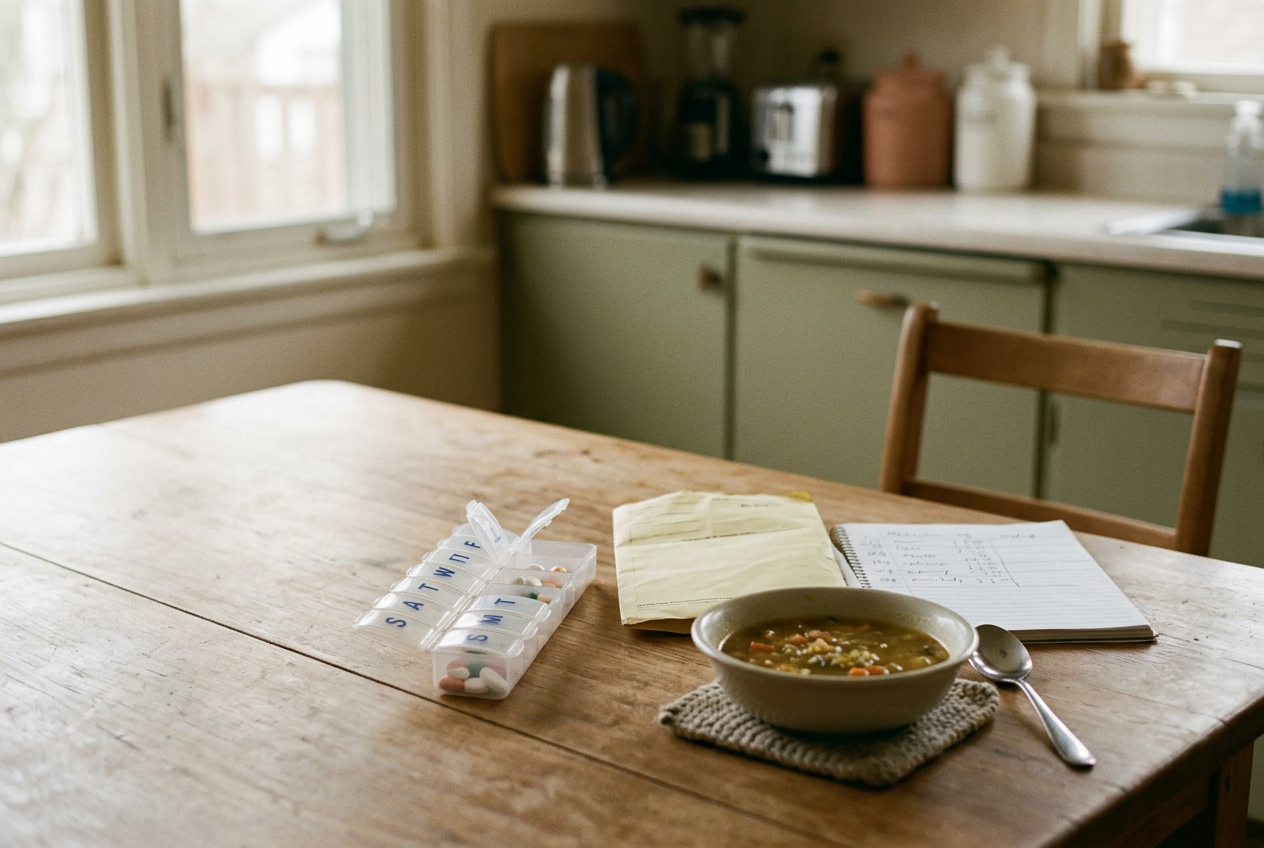
The notebook started at the hospital in June 2022. Her uncle wrote the month at the top of the first page, followed by the date of her next appointment and a short summary of what the discharge nurse had explained. His niece had spent eleven days in the hospital after a frightening stretch of little sleep, confused speech, and beliefs that made sense to her but alarmed the adults around her. The hospital described the event as first-episode psychosis.
At 17, she could still make jokes about his cooking. She could also become quiet halfway through a sentence and look past him, which made him wonder whether he should ask what was happening or let the moment pass. He wrote those moments down.
He had bought the notebook for logistics. He needed somewhere to keep appointment dates, questions for the specialist, and notes about calls with her school. Within two weeks, it also contained entries about how long she stayed in her room, whether she finished dinner, and how sharply she answered him when he reminded her to charge her phone.
The notebook made him feel prepared. It also made the house feel watched.
A spare room and unfamiliar paperwork
Before the hospitalization, he had been the uncle who arrived with takeout and left before the dishes were done. He rented a place with a spare room, worked a steady maintenance job, and had no children. His sister, the girl’s mother, was dealing with housing instability and her own health problems, so everyone agreed that her daughter needed a quieter place for a while.
Agreement did not settle the practical questions. The uncle needed written authority to speak with the school and handle medical paperwork, and the pharmacy initially could not discuss a prescription with him. He and his sister filled out the necessary documents, then waited while offices updated their records. He kept copies in an envelope under the notebook.
His niece arrived with two bags and a charger that worked only when the cord was bent. He spent $86 on sheets, a lamp, and food he thought teenagers ate. Most of it was wrong. She disliked the cereal and informed him that nobody wanted that many yogurt cups.
The first month, he followed the hospital instructions with the concentration of someone assembling furniture without wanting to admit he had skipped a step. He drove her to appointments, picked up prescriptions, and sat beside her in waiting rooms. When she met privately with her specialist, he held the notebook on his knee and tried not to imagine what was being said.
At home, he watched for changes mentioned by the care team. The problem was that nearly everything could look like a change if he stared long enough. Sleeping late worried him. Staying awake worried him.
A closed bedroom door became information. So did an open one.
He loved her, and he resented that his evenings no longer belonged to him. He resented his sister for needing him, then listened outside his niece’s door when the house had been quiet for too long. Neither feeling canceled the other. There were nights when he wanted to be anywhere else, though he still checked that the porch light was on before she came back from a walk.
The charger argument
Their worst ordinary argument started with the broken charger. His niece borrowed his, carried it into her room, and denied having it when he needed it for work. He saw the cord beside her bed and asked why she had lied. She accused him of searching her room.
He said the door had been open. She told him he made the house feel like the hospital.
Afterward, he opened the notebook and wrote that she had been irritable and suspicious. Twenty minutes later, he crossed out both words.
She was angry because he had looked into her room. She was suspicious because he had been keeping notes about her without explaining what he wrote. Those facts did not answer every concern, but they changed this one.
At a family meeting, the specialist helped them separate a meaningful shift from a single unpleasant exchange. The uncle did not leave with a formula. He understood that context mattered, that patterns unfolded over time, and that his niece remained a teenager who could be rude about a charger without the argument becoming clinical evidence.
He told her about the notebook. She disliked it immediately.
They agreed that he would keep appointment information and practical questions in it, while observations about her behavior would be limited to changes that lasted or interfered with daily life. The agreement was imperfect. Sometimes he wrote something down and later removed the page. Sometimes she asked to see it, then became angry about an entry she had approved the week before.
Still, the notebook changed. The pages contained fewer judgments and more usable details: a school meeting had been moved, the insurance company needed another document, the next prescription pickup would cost $18. He left blank space after medical appointments instead of trying to record every sentence.
His own questions changed too. Early on, he often asked whether she was hearing anything or feeling watched, even when she was annoyed about laundry or wanted to skip a family dinner. Those questions made her feel that every disagreement could be used against her. Later, he asked about the immediate problem first.
If she was upset about school, they talked about school.
This did not make him relaxed. It made him less obvious.
Letting school become school again
Eight weeks after she left the hospital, the school sent a packet of missed assignments that was thick enough to end the discussion before it began. His niece shut it and pushed it away. Her uncle’s first impulse was to make a calendar and start assigning pages.
Instead, he brought the packet to a meeting with school staff. The consequential change was a reduced workload, which meant she could return without first completing every assignment from the weeks she had missed. Other details were handled through ordinary emails and signatures. The packet went into a drawer.
Her return was uneven. Some mornings she got dressed and then said she could not go. On others, she came home complaining about classmates, cafeteria food, or a teacher who treated her too gently. The complaints reassured him more than he wanted to admit.
They sounded familiar.
Five months into living together, she asked to take the bus instead of being driven. He disliked the idea and said so. The care team had encouraged gradual independence, although that phrase did little for him when the bus was late and she did not answer a text. He stood at the window with the notebook on the kitchen table, open to a page where he had written the route information.
She came in carrying a bag of chips. She had missed her stop while listening to music and walked back.
He wanted to lecture her about answering. She wanted him to stop acting as if a late bus meant an emergency. They argued. Nobody opened the notebook.
Recovery did not move in a clean direction after that. There were medication discussions with her specialist, stretches when concentrating at school was hard, and one period of several days when she spoke less and stopped responding to friends. Her uncle noticed because he knew her routines, then shared what he had seen during an appointment. The care team worked with her on what came next.
There were also dull weeks. Dishes collected in her room. She laughed during a movie and refused to explain the joke. He reminded her twice about a permission slip, then found it completed under the notebook where she knew he would look.
By the following spring, his niece was spending more weekends with her mother. The arrangement still depended on housing, health, and what felt manageable to everyone. Her uncle did not know when the spare room would stop being hers. He stopped asking for a date.
The notebook remained on the kitchen table. Its early pages were crowded with underlining and question marks. Later pages had appointment months, grocery requests, and gaps where nothing had needed recording. The crossed-out words from the charger argument were still readable.
Questions people ask
What did support after a first psychotic episode look like at home?
For this family, support included transportation, prescription pickups, school communication, and a stable place to sleep. It also meant tolerating uncertainty between appointments. The uncle noticed changes and shared them with the care team, but the house still had to function as a home where a teenager could close her door.
How did he stop treating every disagreement as a symptom?
He did not stop worrying. He began looking at the immediate reason for a conflict before adding it to the story of her illness, and he paid more attention to changes that lasted or disrupted daily life. A dispute about privacy could remain a dispute about privacy.
What did kinship care change for the uncle?
Taking his niece in gave her steadier housing, but it also gave him responsibilities he had never held, including school communication and medical paperwork. Written authorization mattered because offices could not assume an uncle had permission to act. The administrative work sat alongside cooking dinner and waiting for the bus.
Could she return to ordinary teenage life during recovery?
Her return included a reduced school workload, missed mornings, bus rides, and arguments about borrowed property. None proved that recovery was finished. They showed what daily life looked like while care continued, including the completed permission slip she left under the notebook on the kitchen table.
One story a day
The story of the day, in your inbox
One health journey each morning — no advice, no alarm, just company for the road.