Her Child’s EB Wound Care Took Two Hours Each Evening
For one family, the living room became a wound-care space each evening. A notebook tracked skin changes, dwindling supplies, and the nights exhaustion won.
 Rosa DelgadoNarrator, Caregivers
August 22, 2026 · 8 min read

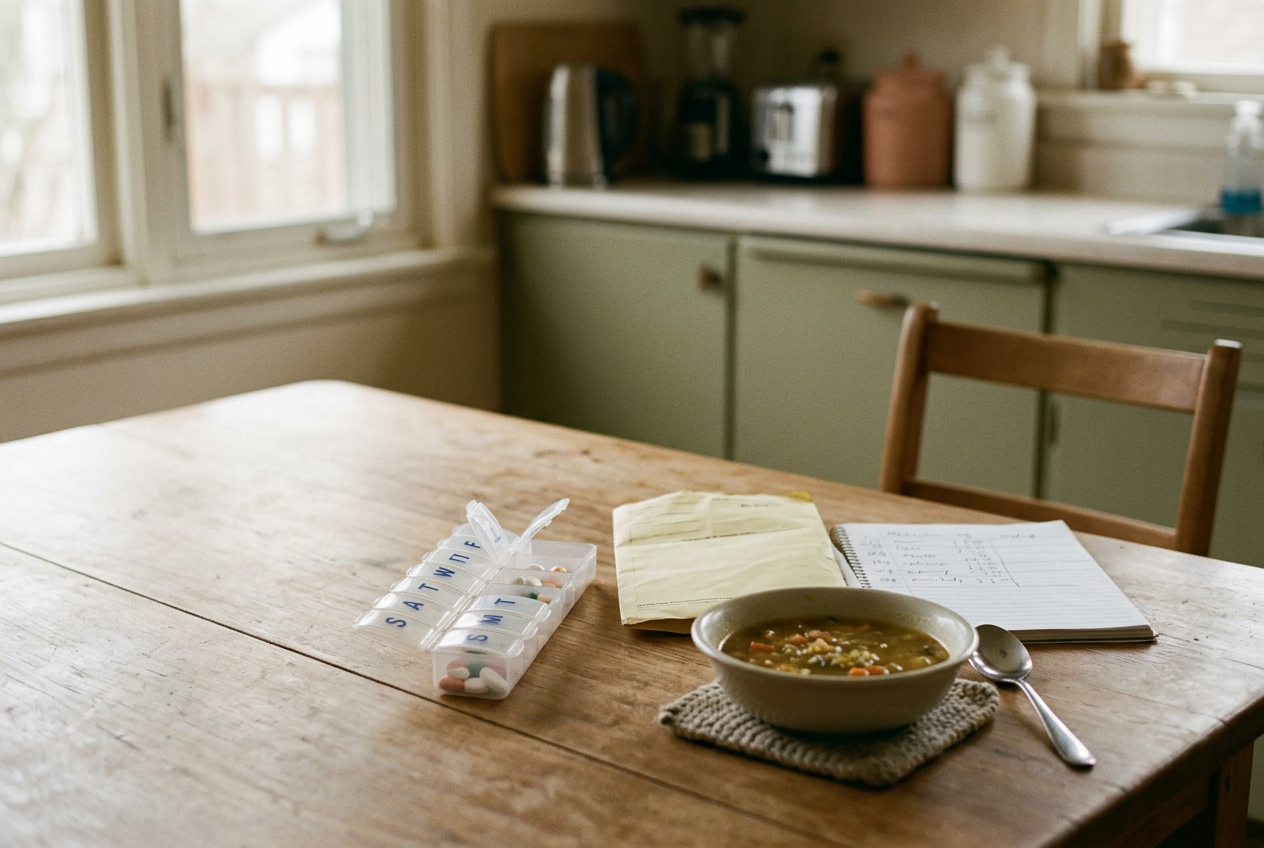
The notebook lived on the kitchen counter, close enough to reach with one clean hand.
Mara, the parent in this composite account, started it when her son was an infant and his specialist asked the family to keep track of blisters, open wounds, and possible signs of infection. By age four, the entries had become a compressed record of family life: right ankle rubbed by shoe, shoulder improving, dressing shipment delayed, slept through removal, cried in bath.
There were grocery reminders in the back. One page held a drawing of a truck.
Her son had epidermolysis bullosa, or EB, a group of inherited conditions that make skin fragile and prone to blistering or tearing from friction and minor injury. The severity and medical needs vary widely. In this family, wound care happened every evening, while a more extensive dressing change could take close to two hours.
Two hours is enough time for dinner to dry onto plates and bathwater to cool. It is long enough for a preschooler to reject three shows, request crackers, and become outraged by a sock.
It is also a long time to hurt someone you love while trying to protect him.
The living room became the treatment room
Mara and her partner used the living room because it had enough open space for the supplies and a screen within view. They put a washable pad on the floor, moved the coffee table, and brought out sealed dressings, gauze, wraps, ointments, gloves, blunt scissors, trash bags, and the notebook.
Some evenings began with a bath to loosen the old dressings. On others, they removed each layer where he sat, stopping when material clung to a wound or when he needed a break. His medical team had shown them how to handle his skin, including how to manage certain blisters and apply the nonstick layers selected for him. Mara never thought of herself as doing a clinical procedure.
She thought about getting through the left leg without making the right one hurt.
Her son watched cartoons and held a toy vehicle. If he became frightened, he kicked, which could injure more skin. If Mara held him still, she could feel his body tighten against her arm, and the fact that restraint was sometimes necessary did not make it feel reasonable in the moment.
Prescribed pain medicine was part of their routine, planned with his medical team, but it did not erase the fear attached to removing a dressing from tender skin. He knew which package meant they were nearing the harder part. He recognized the sound of scissors opening. A child does not need to understand wound care to understand its objects.
Mara narrated ordinary things while she worked. She described what his other parent was making for dinner or where the missing toy might be. Sometimes he answered. Sometimes he screamed until his voice became rough, then asked for water and returned to the cartoon as if everyone had agreed to an intermission.
The old material went into a trash bag. Used gloves followed. Clean dressings covered the open areas, with padding and wraps placed according to the plan his specialist had developed for him. The notebook stayed open nearby, receiving short entries whenever Mara remembered she was supposed to document what she saw.
On the worst nights, she remembered after everything was put away.
Love did not make the work less grueling
Mara resented the routine. She resented the packages that filled a closet and still managed to run out, the laundry stained by drainage, and the way an ordinary family evening could be canceled by one wound that looked different from the previous night. She loved her son with an attention so complete that she noticed how he shifted his weight before he complained. Both facts occupied the same room.
Her partner usually handled cleanup and food while Mara finished wrapping. They had both learned the routine, though each knew different parts of his skin better. Mara could identify the spot near his knee that reopened after active days. Her partner noticed irritation near the edge of a wrap before she did.
They still argued.
One argument began over scissors left beside the sink and moved quickly into every unfinished job in the house. Another started when Mara said she had done more dressing changes that week, which was true, though her partner had made the insurance calls and washed bedding after midnight. Accounting became mean when both of them were tired. It also became irresistible.
Their son listened from the couch, holding the truck. Mara hated that part most and repeated it anyway months later.
The notebook did not record arguments. It showed that his heel was improving.
The supply shipment ran late
Wound care depended on having the right materials in the house, and the family’s margin was often smaller than the boxes made it appear. Different wounds needed different sizes. A package could look full while holding little they could use that evening.
Mara wrote remaining supplies in the notebook because an insurance approval once expired while a shipment was being processed. The supplier and insurer each needed information from the other, and the specialist’s office sent documentation more than once. Mara called the number on the back of the card during work breaks and kept the notebook beside her, though its wound notes were more useful than anything she heard on hold.
With six days of usable dressings left, the family paid $286 for enough material to bridge part of the gap. The charge went on a credit card. They cut back on groceries that week and postponed a car repair, decisions that sounded temporary until another expense replaced them.
The delayed shipment arrived after eleven days.
Mara opened it on the kitchen floor and checked the contents against what her son’s routine required. She did not feel relieved. She felt angry that cardboard boxes could decide whether the evening was merely difficult or impossible, then she carried the packages to the closet and wrote “delivered” in the notebook.
The routine followed them everywhere
Preschool added another layer of planning. His parents explained his skin needs to the adults caring for him and sent the supplies needed for injuries during the day. They wanted him included in play without pretending every activity carried the same risk for him.
A good school day could still produce new wounds. So could a car-seat strap, clothing seam, fall, or enthusiastic hug. Mara learned to examine without appearing to examine, watching how he walked from the classroom and whether he used both hands to climb into the car.
At home, he sometimes asked to play before wound care. Mara often said yes, even though delay meant the routine pushed deeper into an evening already narrowed by dinner and laundry, because four-year-olds measure life in what can happen before the bandages come out.
Other times she said no.
Work became a problem of availability. Mara reduced her hours for fourteen months because appointments and supply calls kept breaking the week apart, while her partner took intermittent leave when wounds worsened or they needed to travel to the specialist. The lost income mattered. So did the professional embarrassment of explaining, again, that home medical care could not be shifted to another evening.
Friends offered help, but the task was hard to hand over. A relative could bring food or sit nearby, yet wound care demanded familiarity with the child’s body and the plan from his medical team. Even willing people became cautious once they saw how easily skin could be injured.
Mara did not blame them. She sometimes blamed them.
What the notebook kept
Eight months after the delayed shipment, the notebook was nearly full. The final pages contained fewer frantic supply counts because the approval had been renewed, though Mara still checked the closet before opening a package.
Her son’s wound-care routine had changed as he grew. He chose his show, helped pass sealed packages, and announced which leg should go first. Participation did not turn the work into a sweet family ritual. Some nights remained loud and messy.
Some ended with one parent eating over the sink while the other carried a sleeping child to bed.
The notebook captured small improvements that Mara might otherwise have missed. A wound near his ankle closed after five weeks. A troublesome area on his back stayed intact through a full preschool week. Beside one entry, her son had pressed a sticker over the words, and Mara left it there.
She also stopped recording every blister. There were too many, and documentation had begun to consume attention she needed elsewhere. She kept notes about changes that mattered to his clinicians, supply problems, and the areas she wanted to remember at the next appointment.
The notebook returned to the kitchen counter after each dressing change. Sometimes a grocery receipt marked the current page.
Questions people ask
How long can EB wound care take at home?
In this family, the evening routine often took close to two hours when several dressings needed changing. The duration varied with the number of wounds, how well old dressings released, the child’s pain and fear, and whether the parents needed to pause. Other children with EB may have very different routines and medical needs.
What do parents record during EB dressing changes?
Mara’s notebook held brief notes about new blisters, wounds that changed, areas that reopened, and concerns she wanted to bring to the specialist. She also tracked dressing supplies after a delayed shipment left the family paying $286 out of pocket. Over time, she recorded less and focused on changes relevant to her son’s care.
How do families handle dressing supply delays?
This family contacted the supplier, the insurer, and the specialist’s office while counting how many days of usable dressings remained. An approval problem delayed one shipment for eleven days, so they bought a partial supply themselves. The notebook helped Mara keep the practical details together while the offices exchanged documentation.
Can another caregiver learn the wound-care routine?
Both parents learned the routine from their son’s medical team and divided the work according to what each knew best. Relatives helped with meals and company, but direct wound care was harder to transfer because it required familiarity with his skin, his reactions, and his individualized plan. The notebook stayed beside the sealed packages and scissors.
One story a day
The story of the day, in your inbox
One health journey each morning — no advice, no alarm, just company for the road.