Her Father Had Metastatic Cancer. She Stopped Answering for Him.
At 35, Elena became her father’s caregiver, note-taker, and unofficial interpreter. A notebook helped her organize his cancer visits, then showed her when she was taking over.
 Rosa DelgadoNarrator, Caregivers
August 7, 2026 · 7 min read

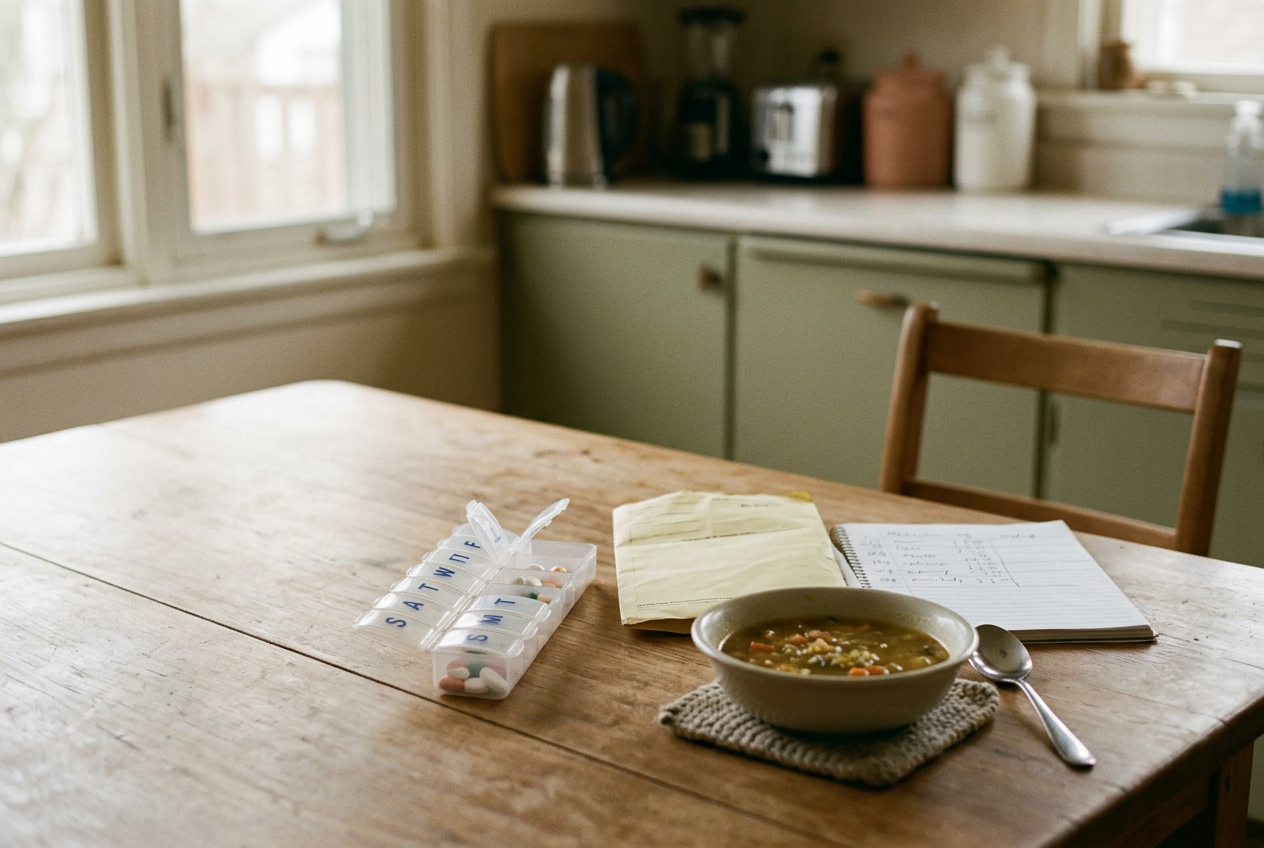
The notebook started on Elena’s kitchen table beside her car keys and her son’s school folder. She wrote the month at the top of the first page, then copied what she understood from her father’s patient portal: prostate cancer, spread to the bones, appointment with the specialist.
She left space underneath. It did not look like enough.
Elena was 35, a single mother with an eight-year-old son and a job that allowed some schedule changes, provided she gave notice and did not need too many changes in the same week. Her father had spent years handling his own primary care appointments in English, which he spoke well enough for work, errands, and conversations with neighbors. Oncology brought a different vocabulary. Even familiar words arrived in unfamiliar arrangements.
At his first specialist visit, Elena sat in the second chair with the notebook open on her lap. Her father understood that the cancer had moved beyond the prostate. He understood that treatment would try to control it. The rest came quickly, with references to imaging, bloodwork, an injection, and another medication that would require insurance approval.
Elena wrote as fast as she could. When her father paused over a sentence, she translated. When the specialist asked about pain, she answered before he did.
That became the pattern.
The notebook became the record
For the first two months, Elena treated every appointment as an information emergency. She wrote down medication names, the month of the next scan, changes in her father’s appetite, and the amount he owed after one visit. The notebook traveled in her work bag, under a lunch container and beside a packet of crayons she kept for her son.
At home, her father called when a portal message appeared. Elena read it, explained what she could, and added a line to the notebook. If the insurance company sent a letter, she called the number on the back of his card during her lunch break. She kept the practical parts moving because somebody had to, and because her father’s fatigue made an afternoon on hold feel larger than it had before treatment.
She was useful. She was also tired of being useful.
There were evenings when her son needed help with homework while her father wanted to review a lab result that had already been reviewed twice, and Elena felt irritation rise before she could hide it. She loved him. She resented the notebook, the portal password, and the way every unknown seemed to land in her lap. None of that canceled the love.
The love did not make the calls shorter.
During visits, her notes grew more complete while her father’s answers grew shorter. The specialist often looked toward Elena after asking him something. She had the medication list. She remembered which side hurt after a long car ride.
She could explain that he had skipped a family dinner because he felt worn out, although her father described the same evening as one when he preferred to stay home.
That difference bothered her later.
The notebook made her feel responsible for accuracy, and accuracy began to mean correction. She filled in pauses. She tightened his stories into timelines. Once, when he started describing how treatment had changed his sleep, Elena interrupted to provide the month it began, then continued until the answer belonged mostly to her.
Her father did not object in the exam room. In the car, he told her that he knew she was trying to help, but he wanted enough time to finish.
Elena put the notebook in the cup holder and drove home without opening it.
An interpreter changed the seating arrangement
Before the next visit, Elena contacted the specialist’s office and asked for a Spanish-language medical interpreter. The hospital arranged one remotely. Her father had not requested this earlier, partly because he was used to managing in English and partly because having his daughter translate seemed easier than adding another person to the conversation.
The interpreter did not remove Elena from the room. It removed one job.
At first, she still jumped in. The specialist asked her father about side effects, the interpreter rendered the question in Spanish, and Elena began answering from the notebook. Then she stopped. Her father described the fatigue in his own order, including the fact that what troubled him most was not missing dinner but needing Elena to drive him to appointments.
That detail had not appeared in her notes.
He also raised a concern he had avoided discussing through his daughter. Prostate cancer treatment had affected an intimate part of his life, and the presence of an interpreter gave him a way to speak directly with the specialist without making Elena choose the words. She kept her eyes on the notebook. For once, not writing felt like the useful thing.
The visit took longer than the compressed versions Elena had been producing, though nobody measured it. Her father circled back. He asked for an explanation to be repeated. The specialist looked at him while answering, and Elena wrote down the follow-up plan after the interpreter finished instead of trying to translate and take notes at once.
On the ride home, her father corrected one line in the notebook. Elena had written that his pain was worse. He said it was more frequent, not worse. She crossed out two words and replaced them.
That small edit changed how she used the notebook after that. Before each appointment, she opened to a blank page with her father at the kitchen table and asked what he wanted included. She marked his concerns in the margin, then added her own observations below them. The distinction was not elegant.
It was visible.
She still handled the portal with his permission. She still called about an insurance delay that held up one medication for eleven days, and she still kept copies of appointment summaries because paper remained easier for her father to review than a string of electronic messages. Caregiving did not become lighter just because the conversation improved.
Some weeks, the interpreter was available in person. Other visits used a screen or telephone. Once, the connection failed and Elena translated again, but she tried to preserve the pauses she had previously treated as empty space. Her father took longer to describe the ache in his hip.
She waited.
The notes stopped being a script
Eight months after the first specialist visit, the notebook was more than half full. It held scan months, medication changes, parking receipts, and a drawing her son had made while waiting at home with a neighbor. Elena could find most facts faster than anyone else in the family, an ability that brought no promotion and generated several unpaid errands.
Her father’s treatment continued. Some results brought relief. Others produced another appointment and another page. Elena learned that information could be recorded without being settled, which was inconvenient because she preferred boxes she could check and explanations she could repeat to relatives.
At one visit, the specialist discussed a change in treatment after imaging showed new activity. Elena felt her hand tighten around the pen. Her father asked the interpreter to repeat the explanation, then asked the first follow-up himself. He wanted to know how the change might affect his ability to drive his grandson after school.
Elena had prepared different concerns. She had a line about the insurance approval and another about fatigue. Both mattered. Neither was the question he chose first.
She passed him the notebook.
He looked at the page, added a few words in Spanish, and handed it back when the specialist began explaining the next steps. Elena resumed writing. She did not become less involved; over the following month she coordinated bloodwork, rearranged one workday, and brought groceries when her father did not feel like shopping. She also snapped at him after he misplaced an appointment summary, then found it under the notebook where she had put it herself.
There was no clean division between his responsibilities and hers. Metastatic cancer did not respect one, and neither did a healthcare system that placed results, coverage notices, and scheduling messages in separate places. Still, the exam room had changed. The interpreter carried the medical language.
Her father carried his priorities. Elena carried the notebook.
At the next visit, she set it on the space between their chairs rather than opening it on her lap.
Questions people ask
Should a family member interpret during cancer visits?
Elena interpreted because she was present and understood both languages, but translating medical information while listening, taking notes, and reacting as a daughter became too much. The hospital’s professional interpreter gave her father a direct route into the conversation and allowed Elena to concentrate on the record and her own concerns.
How can a caregiver take notes without taking over?
Elena began separating her father’s concerns from her observations on each notebook page, then waited for him to answer first. She still corrected dates and recorded follow-up details, but the notes stopped serving as a script for what he was supposed to say or what the illness was supposed to mean to him.
Can a caregiver use a parent’s patient portal?
Elena used the portal with her father’s permission, which let her track messages and appointment information without pretending the account was hers. The access did not make every result understandable. When new information appeared before a visit, she recorded it in the notebook and left the medical explanation for the clinical team and interpreter.
What if a parent wants family to do the talking?
Her father sometimes asked Elena to explain a timeline or handle an insurance call, and she did. At visits, she learned to check whether he wanted her to speak rather than assuming silence meant permission. Before the next scan discussion, he placed a mark beside the first concern on the notebook page.
One story a day
The story of the day, in your inbox
One health journey each morning — no advice, no alarm, just company for the road.