After His Heart Attack, She Tracked Every Visit and Injection
A South Carolina wife kept her husband’s appointments, LDL results and twice-monthly injections on one paper calendar. Then she had to work out where helping ended and policing began.
 Rosa DelgadoNarrator, Caregivers
August 6, 2026 · 7 min read

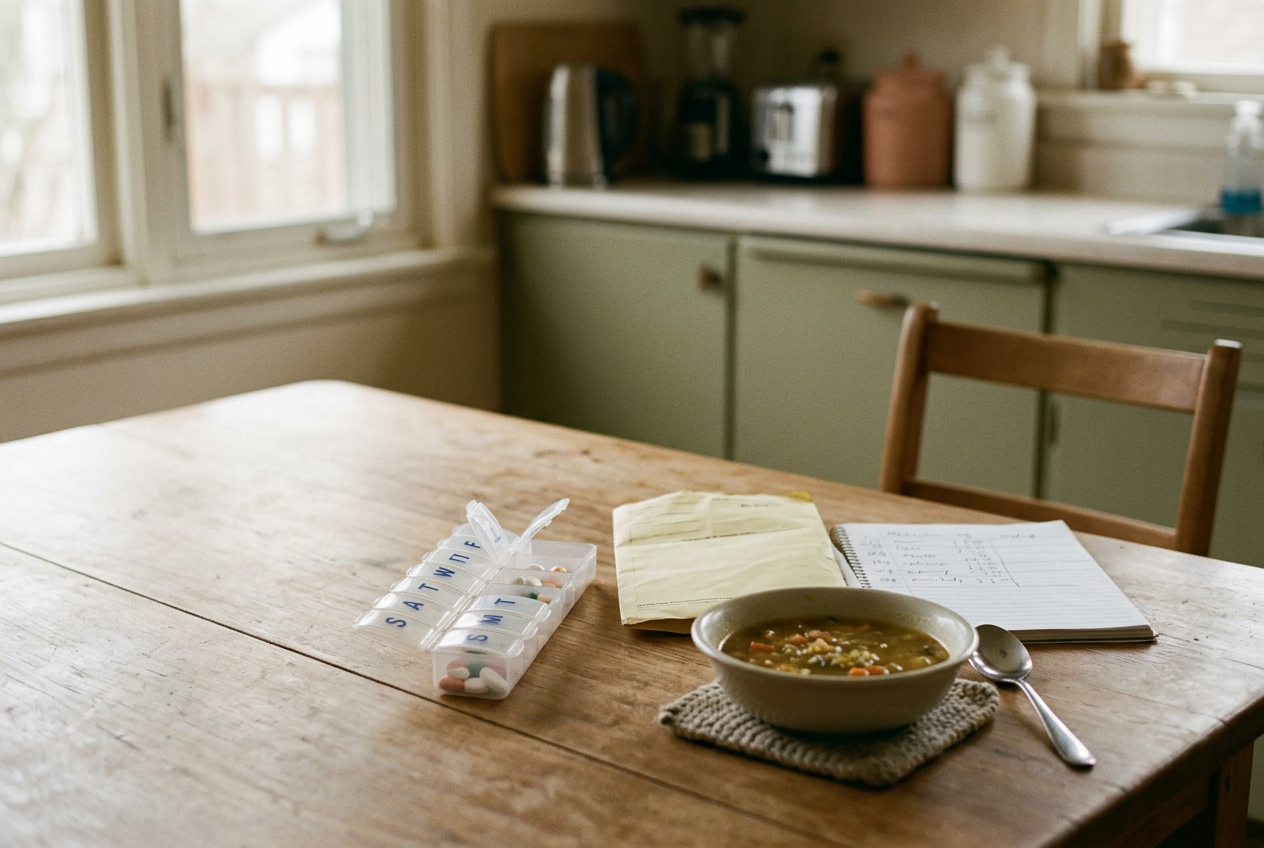
The paper calendar had always lived on the kitchen counter, mostly under grocery coupons and restaurant schedules. After her husband’s heart attack in May 2022, it stayed open to the current month. Cardiology visits went in ink. Lab results were written along the bottom.
Twice a month, she drew a circle around the date of his injection, and he added a check after he took it.
He was 59 and managed a restaurant in South Carolina, work that made regular meals and predictable evenings unlikely. He had felt pressure in his chest during a shift and tried to finish what he was doing before a coworker insisted he leave. At the hospital, tests led to treatment for a heart attack, followed by new medications, follow-up visits and the chart language they learned to recognize: atherosclerotic cardiovascular disease.
She came home with his discharge papers in a folder and a fear that attached itself to ordinary things. A plate with fries on it. A refill sitting at the pharmacy. The pause before he answered when she asked how he felt.
For the first six weeks, she managed the details because he was tired and because restaurant schedules do not respect cardiology appointments. She called offices during her lunch break, put lab slips in the folder and copied every appointment onto the paper calendar. This was useful. It was also the beginning of a problem neither of them knew how to name yet.
The calendar gets crowded
His first follow-up cholesterol result remained higher than his specialist wanted after the heart attack. A later test showed his LDL cholesterol at 137 mg/dL. The specialist discussed adding a PCSK9 inhibitor, an injectable cholesterol-lowering medication, because his cardiovascular disease and earlier treatment made lowering that number a priority in his care.
The approval took about seven weeks. The first pharmacy screen showed an estimated cost of $1,147, which she wrote in the calendar margin because there was nowhere else to put the shock. His doctor’s office sent more information to the insurer, and she made calls using the number on the back of the insurance card. Once the coverage and financial assistance were settled, their cost was $15 per fill.
When the first cartons arrived, they went into the refrigerator. The calendar acquired two more circles each month.
Her husband learned to give himself the injections. She did not need to prepare them or stand beside him, but she still found reasons to enter the kitchen near the scheduled date, opening the refrigerator for mustard they did not need or asking whether he had seen the circle. If the check mark did not appear, she asked again.
He disliked being monitored in his own house. She disliked that he had once tried to finish a restaurant shift while having chest pressure. Both facts remained true, and neither made dinner pleasant.
The calendar also held the results that encouraged them. Four months after he started the injections, she wrote 58 mg/dL at the bottom of the page. He ran his finger under the number. She wanted to frame it, which he said would be a strange choice for kitchen decor.
Instead, she closed the calendar and made room for two plates.
When helping starts to feel like watching
Food became the hardest territory. Before the heart attack, he often ate at work, standing near the kitchen or in the office between problems. At home, she began noticing salt, portions and whether he reached for another serving. She had absorbed a large amount of information in a short time, and much of it returned at the table even when nobody had invited it.
Sometimes she made a comment. Sometimes she pressed her lips together so firmly that the comment was still obvious.
He resented the questions, especially after a shift when he was hungry and did not want dinner reviewed. She resented being left with the calendar, the insurer calls and the memory of the hospital while he acted annoyed about one reminder. She loved him and occasionally wanted him to manage his own refrigerator carton without requiring an audience. Love did not remove the irritation.
Irritation did not mean she wanted to stop helping.
Chest discomfort was worse than food. Any hand placed near his sternum caught her attention. A complaint about indigestion changed the room. She would begin asking for details, and he would become brief, partly because he did not want to alarm her and partly because he did not want every physical sensation turned into an emergency conference.
At a follow-up visit about eight months after the heart attack, they described this pattern to the cardiology clinician. They left with their existing instructions reviewed and a simpler division of responsibility: he would not hide symptoms, and she would not repeatedly question him after he had explained what he was feeling and followed the plan from his care team. The agreement did not make her less afraid. It gave them something to refer to besides fear.
The paper calendar changed too. She stopped writing down meals and stopped marking whether he had walked, two habits she had picked up without discussing them with him. Appointments, lab results and injection dates stayed. Those were shared logistics.
The rest belonged to him.
The check mark becomes his
By the second year, her husband had taken over more of the medication routine. The refill reminders went to his phone. He put the check mark on the calendar after each injection, usually without prompting, although there were months when a circle sat empty long enough for her to notice it every time she crossed the kitchen.
Once, after a restaurant staffing problem disrupted the week, the scheduled day passed. She pointed to the circle. He said he knew, contacted his doctor’s office for guidance and handled the next steps himself. She did not make the call.
This restraint looked unimpressive from the outside. Inside their marriage, it was work.
She still keeps the calendar. Cardiology appointments can be scheduled months ahead, and lab results are easier for both of them to find on paper than in a portal with several menus. When a result arrives, she writes the number at the bottom and leaves the calendar open. He can look or not.
There are lapses. She has asked about an injection he already took. He has forgotten to add the check. A meal at the restaurant has included food they once would have debated in the kitchen, and she has chosen not to request an accounting.
Their arrangement is not a clean transfer of responsibility. It is a repeated decision about which details belong on the calendar and which do not.
Nearly two years after the heart attack, the folder of hospital papers remained in a drawer. The calendar stayed on the counter, with an appointment written several months ahead and two injection dates circled in the current month. Beside the most recent circle was his check mark, angled into the next square because he writes quickly.
Questions people ask
Why was a
PCSK9 inhibitor added after his heart attack?
In this story, his specialist discussed the injectable medication after his LDL cholesterol remained above the goal set for his care despite earlier treatment. His history of a premature heart attack and atherosclerotic cardiovascular disease shaped that conversation. The decision and insurance approval involved his cardiology team, pharmacy and health plan.
How did they keep track of twice-monthly injections?
They circled each scheduled date on a paper calendar kept on the kitchen counter. At first, his wife prompted him and recorded nearly everything. Later, refill reminders went to his phone, and he added the check mark himself after an injection, leaving the calendar as a shared record rather than her private monitoring system.
What did she do when he mentioned chest discomfort?
Early on, she asked repeated questions because his heart attack had begun with symptoms he tried to work through. At a follow-up visit, they reviewed the care team’s existing instructions and agreed that he would report symptoms honestly while she would stop questioning him once he had explained what was happening and followed that plan.
Did insurance cover the PCSK9 medication?
The first pharmacy estimate was $1,147, and approval took about seven weeks while the doctor’s office provided additional information. After insurance coverage and financial assistance were arranged, their cost was $15 per fill. She wrote both amounts in the paper calendar, one in an early margin and one beside the first checked circle.
One story a day
The story of the day, in your inbox
One health journey each morning — no advice, no alarm, just company for the road.