Deferring a Life at Nineteen
When Julian delayed university to care for his father, nobody warned him about the paperwork, the isolation, or the complicated guilt.
 Rosa DelgadoNarrator, Caregivers
July 11, 2026 · 5 min read

The email and the plastic pill sorter
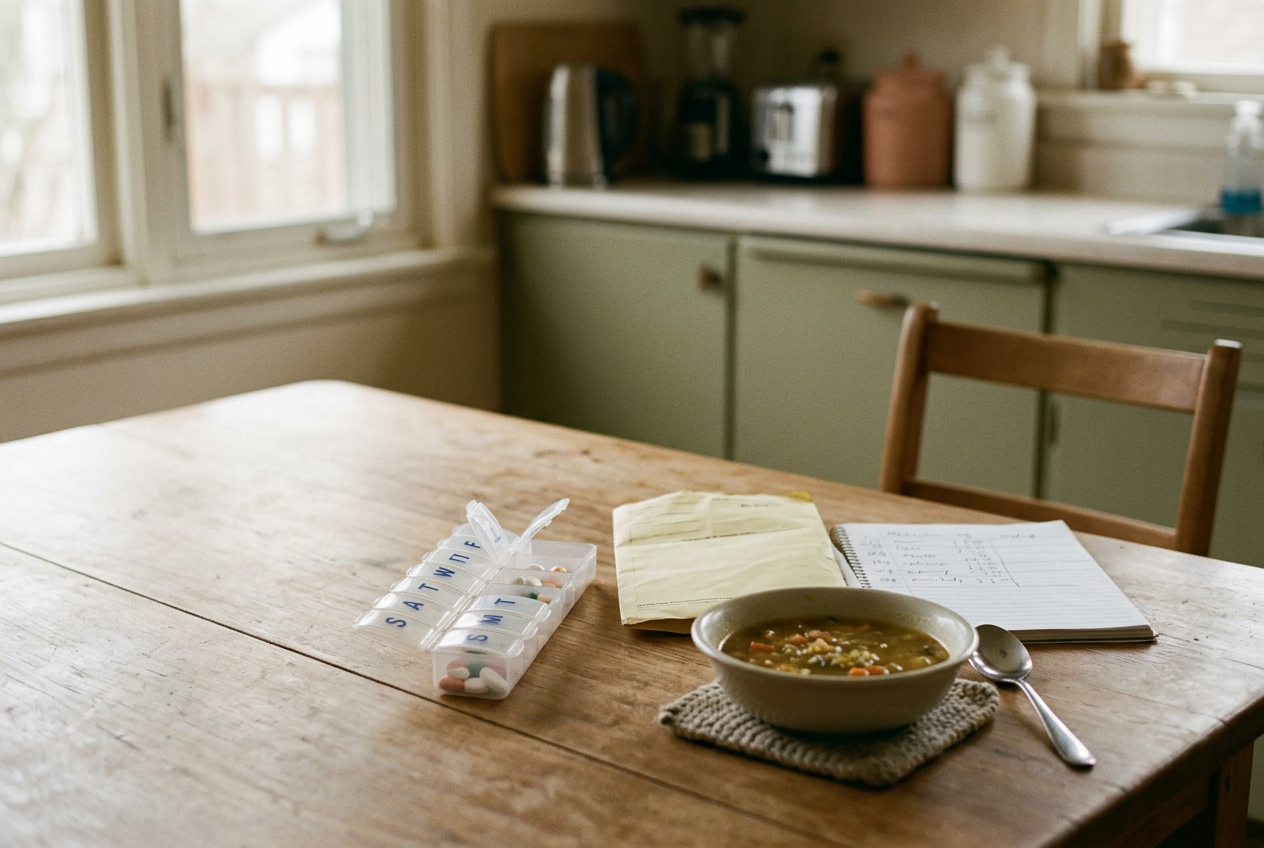
When Julian was nineteen, his email inbox contained two main categories of correspondence: polite confirmations of deferral from an admissions office in Yorkshire, and heavy PDF discharge summaries from a regional hospital trust. He spent the morning of his nineteenth birthday sitting at the kitchen table, filling a seven-day plastic pill dispenser with five different medications. The printed letters on the lids (M, T, W) had already begun to rub off under his thumb, leaving faint blue smears on the plastic.
His father had suffered a severe stroke three weeks after Julian completed his final school exams. In an afternoon, the house transformed from a quiet, predictable place into an improvised annex of the local health authority. Julian had secured a place to read history starting that autumn. Instead of packing crates for student housing, he sat down and typed a formal, slightly stiff email to the college department, asking if his place could be deferred for twelve months. Twelve months later, he would sit in the same chair and type the exact same request a second time.
Nobody prepares a teenager for the administrative weight that accompanies a sudden medical crisis. The public conversation about caring focuses almost entirely on emotional devotion or physical strain. You expect the tiring mechanics of helping a grown man move from a bed into an armchair without straining a shoulder joint. You expect the heavy sleepiness that settles behind your eyes by mid-afternoon. What nobody mentions is the sheer volume of paper, the endless hold music, and the relentless follow-ups required to secure simple equipment.
The mechanics of the home shift
The domestic routine settled into a strict grid within a month. The community nurse arrived at seven fifteen each morning, her rubber-soled shoes squeaking down the hall linoleum. Julian learned quickly to have the kettle boiling before she pressed the doorbell. A nurse supplied with immediate hot tea was a nurse who would take an extra three minutes to demonstrate how to position a sliding sheet without pinching skin.
He became an expert in minor logistics. He memorised the exact capacity of plastic urine bottles and discovered that rinsing them with cold water first prevented the plastic from clouding. He knew which local pharmacy kept the thickest barrier cream in stock, and which supermarket checkout assistant would look the other way when he bought extra packets of liquid paracetamol.
The care system operates on the unspoken assumption that family members have endless unpaid hours to spend waiting on hold between nine and five.
The continuous administrative friction was far more exhausting than the physical labor. Julian spent hours navigating the maze of benefit rules, where earning a single pound over the weekly limit meant losing support. He filled out thirty-page forms regarding disability payments, answering detailed questions about whether his father could navigate two steps unassisted or button a shirt without distress. Typing those answers felt like writing a daily inventory of his father's losses.
A different dialect of youth
The emotional reality of those two years was not a dramatic grief. It was an odd, flat vigilance punctuated by moments of intense, uncomfortable irritation. He sat beside his father's bed at two in the morning, listening to the coarse, wet rattle of chest congestion, holding a plastic cup with a flexible straw.
His father, a man who had spent forty years working as an industrial surveyor and could spot a millimetre of misalignment in a doorframe, sometimes spent five minutes trying to guide a spoon of porridge to his mouth. When the spoon dropped onto the duvet for the third time in ten minutes, Julian felt a sudden, hot flash of resentment. A second later, a wave of cold shame followed. The resentment and the love sat together in his chest, completely unresolvable, for months on end.
During his first winter as a caregiver, his old school friends returned home from their first term at college. They met at a local pub. Julian sat in a corner booth, wearing a sweater that smelled faintly of hospital-grade disinfectant, listening to them debate hall tutors, cheap drinks brands, and essay deadlines. They spoke in a fast, energetic dialect that he had understood fluently six months earlier, but now sounded entirely foreign.
When they asked how his gap year was going, he offered a brief, neutral summary. He said he was helping out at home while his father recovered. He did not describe the manual hoist, the skin tears, or the four-month wait to get an occupational therapist to visit the house. "It must be nice to have a break from studying," one friend said before heading to the bar. Julian drank his drink, checked his phone, and remembered he needed to be home by eight thirty to administer night medication and turn his father onto his side. He did not blame his friends. Their lightness was appropriate for nineteen. But a thick, invisible wall had dropped between his experience and theirs.
Carrying the habit forward
When Julian finally arrived at college two years later, his father had moved into a specialist care facility capable of managing his advancing vascular dementia. Julian was twenty-one years old, living in a corridor of eighteen-year-olds whose primary concern was managing their shared kitchen fridge. The shift was disorienting. He woke up at six every morning, his pulse spiking at the sound of a clinking pipe, convinced it was the emergency bell he had rigged in his father's bedroom. He kept his phone on his desk during lectures, set to vibrate, his hand constantly checking the screen for calls from social services. It took months to unlearn the posture of emergency.
People often told Julian that he was remarkable, or that he had shown incredible strength for his age. The praise always felt slightly off-target. He had not been remarkable; he had simply been the only person in the house with functional knees and a valid driving license.
What young caregiver need to hear is not that they are heroes. They need practical truths. They need to know that navigating adult social care requires the persistence of a tax auditor. They need to know that feeling angry at an ill parent is a normal human response to exhaustion. Above all, they need to know that putting your life on pause for two years changes the shape of your youth, but it does not mean your life has ended before it begins.
Questions people ask
What is it like to delay university to care for a parent?
For Julian, it meant replacing student life with medication schedules, physical care, benefit forms, and long waits for support. He became isolated from friends whose lives still revolved around college, even though he did not blame them for the distance.
Is it normal to feel angry while caring for an ill parent?
Julian felt sudden resentment during exhausting care tasks, followed almost immediately by shame. He learned that anger and love could exist together, and that irritation was a human response to relentless strain rather than proof that he did not care.
How did caregiving affect Julian when he finally started university?
He arrived two years later with habits shaped by constant vigilance. Early noises startled him, he kept checking his phone for calls from social services, and it took months to stop expecting an emergency.
One story a day
The story of the day, in your inbox
One health journey each morning — no advice, no alarm, just company for the road.