After Seven Weeks in the ICU, His Wife Became His Recovery Coach
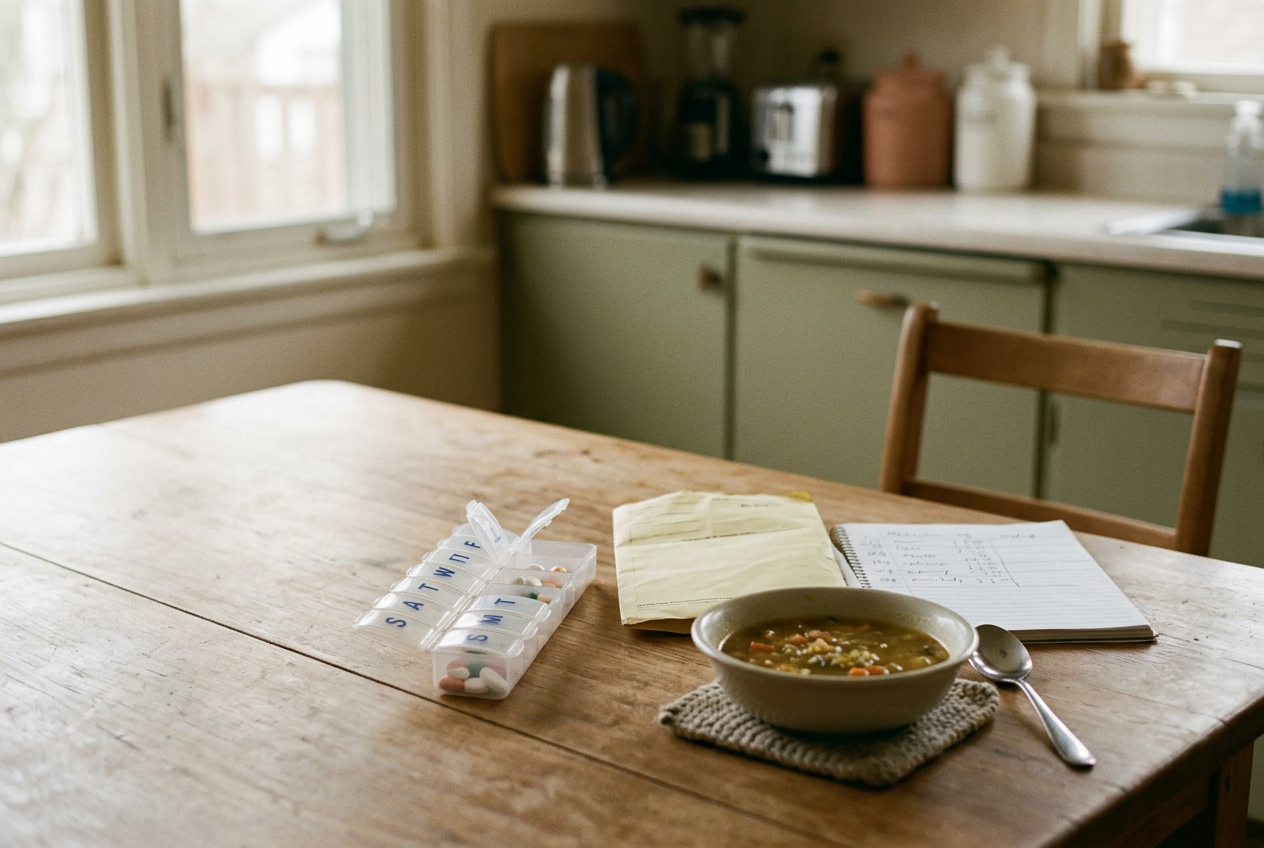
Daniel came home weak, forgetful, and frightened after an extended ICU admission. Elena’s notebook moved from recording hospital updates to tracking the uneven work of recovery.
 Rosa DelgadoNarrator, Caregivers
August 14, 2026 · 8 min read

Elena bought the notebook during Daniel’s first week in intensive care. She wrote down what she could understand from the hospital team, along with the names of medications she had never heard before and questions that escaped her whenever someone in scrubs entered the room.
For seven weeks, the notebook lived beside her phone. Its pages held updates for relatives, parking receipts folded in half, and a running count of how many nights Daniel remained on the ventilator. Elena was the person in the second chair, except when there was no chair or she had to leave the hospital and sit in her car.
Then Daniel came home.
The hospital bed was gone, along with the monitors and the steady arrival of people who knew how to move him. Elena placed the notebook on the kitchen counter and started a new page. She wrote the dates of physical therapy appointments, the $40 copay beside each one, and the questions Daniel repeated after breakfast.
He asked whether the hospital knew where he was. He forgot that his brother had called. A trip from the bedroom to the kitchen left him gripping the counter, while Elena stood close enough to catch him and tried not to look as worried as she felt.
The discharge papers had described follow-up visits and rehabilitation. They had not prepared either of them for how many parts of ordinary life could become work at once, or how quickly the spouse who had spent weeks waiting for updates could become a driver, scheduler, spotter, historian, and witness to a mind that did not always behave like the one she knew.
The notebook changes jobs
Daniel’s primary care doctor later used the term post-intensive care syndrome, often shortened to PICS. It describes physical, cognitive, and emotional problems that can appear or persist after critical illness and intensive care. Daniel’s experience included severe weakness and gaps in short-term memory. Nightmares arrived after he fell asleep, and certain mechanical sounds made him tense.
A clinical psychologist who works with ICU survivors told me that families may expect recovery to resemble healing from a single injury: the body improves, strength returns, and life resumes. PICS can be harder to understand because symptoms cross boundaries. A person may look stronger while remaining unable to follow a conversation, or remember an appointment yet become overwhelmed in a grocery store.
Elena saw those mismatches every day. Daniel could discuss a baseball game from years earlier but lose the thread of a message he had read minutes ago. He was proud when he managed the porch steps, then furious when she reminded him to use the railing.
She understood the anger. She resented it anyway.
At physical therapy, Elena waited with the notebook open on her lap. Daniel worked on standing, balance, and the controlled movements that had once required no thought. On the drive home he often remembered little about the session, so she wrote down what had happened in plain language and left space for the next appointment.
During the first eight weeks, the copays totaled $640. The amount mattered, but the harder expense was the way every appointment occupied the day around it. Daniel needed time to get dressed and recover from the drive. Elena needed to move work calls, find the insurance card, and remember which entrance had fewer steps without making him feel that she had planned the entire trip around his limitations.
The notebook became evidence that progress had occurred even when neither of them could feel it. One early page recorded that Daniel had needed help rising from a chair. Six weeks later, Elena noticed she had stopped writing about the chair.
She did not circle the improvement. She had laundry running and a call from the billing office to return.
Recovery does not stay in lanes
The cognitive problems were less visible than the weakness, which made them easier for other people to misread. Friends saw Daniel walking and assumed he was nearly back. During visits, he could sound like himself for a while, especially if the conversation stayed familiar. After they left, he sometimes slept for hours or asked Elena what they had discussed.
Elena became his external memory. She placed appointments in the shared calendar, repeated instructions from the doctor’s office, and gave Daniel one piece of information when a full explanation made him shut down. None of this felt noble while she was doing it. It felt like being interrupted.
One afternoon, Daniel accused her of hiding his car keys. She had placed them in a drawer after the rehabilitation team raised concerns about his attention and reaction time. He remembered the missing keys but not the conversation that preceded their disappearance.
Elena wanted him safe. She also wanted to finish eating lunch without defending every decision she had made on his behalf. Love did not remove the resentment, and resentment did not mean she wanted to leave. Both sat at the kitchen table while the food cooled.
The psychologist described this conflict as common among family caregivers after intensive care. During hospitalization, vigilance has a clear target: survive the next update, understand the next procedure, answer the phone. At home, vigilance spreads into meals, stairs, sleep, paperwork, and the possibility that the person you protected will experience your help as control.
Daniel began cognitive rehabilitation after the primary care doctor reviewed Elena’s notes and referred him for further evaluation. The sessions focused on how his attention and memory functioned in daily life. At home, he used a calendar and short written reminders, while Elena practiced waiting before supplying a word or correcting a detail.
Waiting was harder than it sounds. A pause that gave Daniel room to retrieve an answer also gave Elena enough time to wonder whether he had forgotten, whether she should intervene, and whether standing silently beside the counter had somehow become her main occupation.
The notebook changed again. Earlier pages had documented every confusion because Elena feared missing something important. Later pages recorded fewer incidents and more patterns: crowded places exhausted him; poor sleep made conversation harder; therapy days required little else. Those observations helped during appointments without turning every hour at home into a test.
The person in the second chair comes home too
Elena did not leave the ICU with a discharge plan for herself. She had trouble sleeping and kept her phone volume high, even though Daniel was in the next room. At the grocery store, the sound of an overhead announcement made her heart race. She abandoned the cart and went home with bread.
For months, she insisted that Daniel’s needs were the real ones. His legs shook. His memory failed. He had been the patient.
The psychologist noted that caregivers can carry their own fear, low mood, intrusive memories, or exhaustion after a critical illness, even when they never occupied the hospital bed. Those experiences may remain hidden because the practical work keeps moving and because relatives tend to ask how the survivor is doing.
Elena eventually told her primary care doctor that she was sleeping badly and could not stop checking on Daniel. The conversation did not reduce the number of appointments, but it changed the way she understood her own reactions. She also began letting Daniel’s sister drive him to physical therapy twice a month, an arrangement that produced guilt, relief, and several texts about where the notebook was.
It was always on the kitchen counter.
Daniel disliked the notebook by then. To him, it represented the version of himself who could not remember a phone call or cross a room without help. To Elena, it held facts she had been solely responsible for carrying. They compromised without calling it a compromise: she stopped bringing it to every appointment, but kept writing in it when something changed.
Nine months after discharge, Daniel still tired faster than he had before the ICU. He was walking without Elena beside him and managing more of his calendar. He sometimes searched for a familiar word. She sometimes answered too quickly.
Their life had not returned to its previous setting. Elena no longer measured each day against the week before the illness, which was useful because that comparison had made nearly everything look like failure. She measured less often altogether.
The final pages of the notebook remained blank for weeks. Then Daniel opened it before a follow-up visit and wrote down two things he wanted to discuss. His handwriting looked ordinary. Elena noticed, said nothing, and put the notebook beside the car keys.
Questions people ask
What does post-intensive care syndrome look like at home?
In this family, PICS appeared as weakness, poor stamina, memory gaps, nightmares, and difficulty handling busy environments after an extended ICU admission. The symptoms did not improve together. Daniel could walk farther while still losing track of conversations, which made his recovery easy for visitors to overestimate.
Who coordinates care after an ICU discharge?
Elena found that coordination shifted among the primary care doctor, rehabilitation clinicians, and the family. No single person managed every part. Her notebook helped her describe changes across appointments, while referrals connected Daniel with physical therapy and cognitive rehabilitation after his doctors reviewed how he was functioning at home.
Does insurance cover rehabilitation for PICS?
Coverage depended on Daniel’s plan and the type of service. His family used the number on the back of the insurance card to clarify benefits, and physical therapy required a $40 copay per visit. The first eight weeks cost $640, before transportation and missed work were considered.
How long can recovery after intensive care take?
Daniel’s recovery continued beyond nine months, with strength, attention, sleep, and confidence changing at different rates. His family stopped treating one good day as proof that recovery was finished. Before a later follow-up visit, Daniel opened the notebook himself and placed it beside the car keys.
One story a day
The story of the day, in your inbox
One health journey each morning — no advice, no alarm, just company for the road.