After Bariatric Surgery, His Husband Counted Every Tiny Cup
A school custodian came home from bariatric surgery needing help with drinks and changing food textures. His husband had to learn where caregiving ended and control began.
 Rosa DelgadoNarrator, Caregivers
August 9, 2026 · 8 min read

The plastic medicine cup appeared on the kitchen counter before the school custodian had taken off his hospital wristband. It was small enough to disappear behind the dish soap, marked in ounces, and suddenly important to both men for different reasons. The patient saw another assignment from the hospital. His husband saw a way to keep track of something that seemed too consequential to leave to memory, especially when neither of them had slept much in two nights.
For eight months before bariatric surgery, the custodian had attended appointments, completed the hospital’s requirements and arranged leave from the public school where he had worked for 16 years. He was used to jobs with visible endings: a trash bin emptied, a spill cleaned, a door that opened after he fixed the latch. Recovery did not offer that satisfaction. Drinking could feel uncomfortable.
Food had rules that changed by stage. Fatigue arrived without respecting the plans either man had made.
His husband took charge of the tiny cups. He lined a few beside the sink, filled one, and moved it across the counter after it was empty. The arrangement was not part of the hospital paperwork. It was what he devised after trying a notebook and discovering that neither of them wanted to write down every swallow.
The cup changed sides. That was the record.
The cup changes sides
During the first 12 days at home, the husband noticed nearly everything. He noticed which chair made it easier for the custodian to stand, how often he drifted off during television, and whether the cup stayed on the wrong side of the counter for too long. He kept the hospital discharge papers nearby, though he disliked reading the section about concerning symptoms because each line gave him something new to observe.
The custodian disliked being observed. At school, he managed supply deliveries and minor repairs without anyone following him through the hallways. At home, his husband watched him lift a cup. One afternoon, after another reminder, he pushed it away harder than necessary.
His husband took the cup to the sink harder than necessary. Neither action broke anything, which was fortunate because they were both too tired to clean up a symbolic mess.
He resented the monitoring and loved that somebody had learned the food stages, washed the small processor and kept the surgical team’s contact information near the discharge folder. His husband loved him and resented becoming responsible for information the patient sometimes refused to discuss. The tension did not cancel the tenderness. It sat beside it on the counter.
Near the end of the second week, the custodian could not keep drinks down and grew much weaker than he had been the day before. His husband stopped using the cups as a private reassurance and called the surgical team, describing what had changed rather than trying to interpret it. They were directed to the hospital, where the custodian was evaluated and received fluids before returning home. The experience did not prove that constant watching was right.
It made watching harder to stop.
For several days afterward, every unfinished cup carried too much meaning. His husband would glance at it, then at the custodian, who could feel the glance even when he was facing the television. A reminder about drinking could become an argument about whether he was taking recovery seriously, followed by a second argument about whether his husband thought he was incompetent. They were rarely arguing about the cup alone.
Food becomes household work
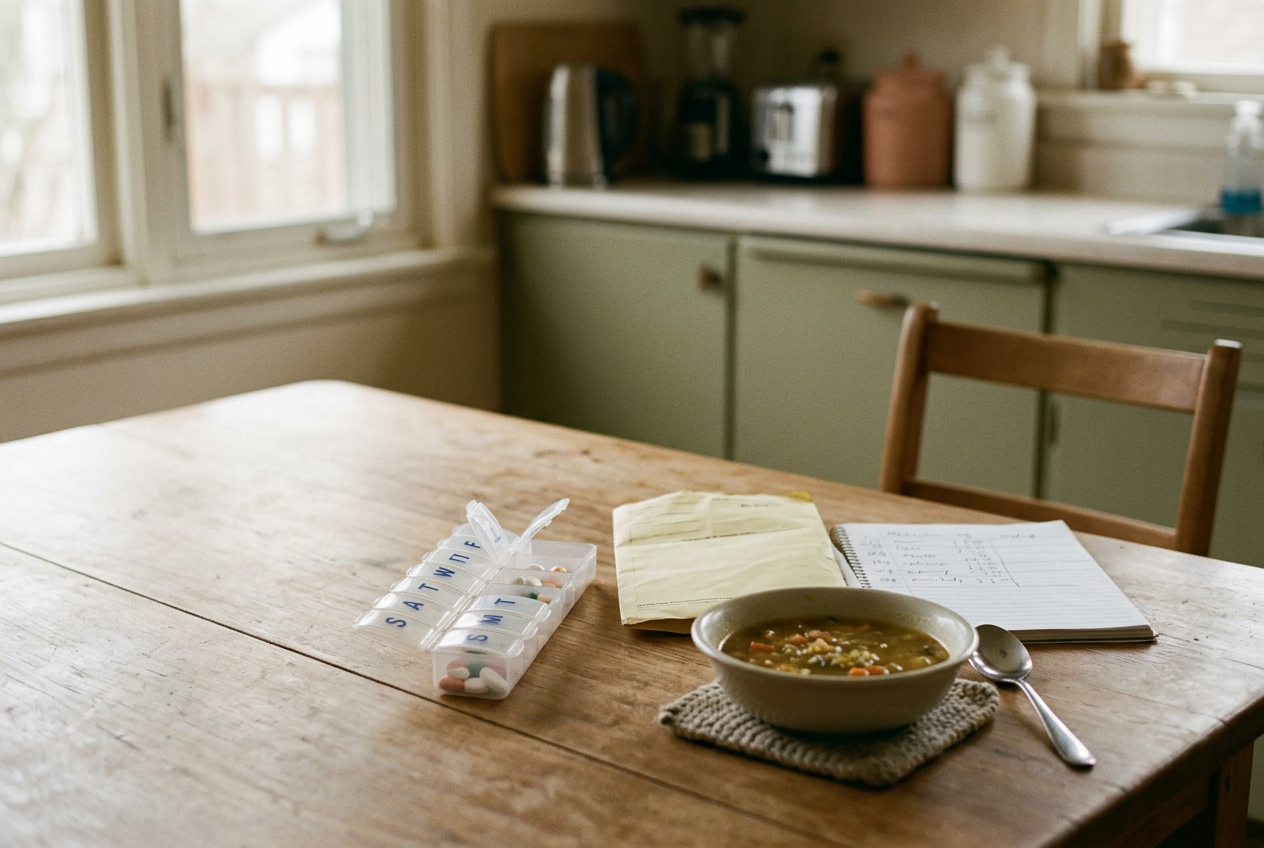
As the surgical team advanced the custodian through different food textures, his husband handled much of the preparation. He strained soup during one stage and used the small processor during another, then washed parts that seemed out of proportion to the amount of food produced. A serving could fit into a small bowl. The cleanup still occupied the sink.
The custodian had expected eating less. He had not expected food to become a household project, with his husband reading the team’s instructions while trying to judge whether a texture was smooth enough and whether a new food had gone well. On difficult days, the husband’s practical questions sounded to him like an inspection. To the husband, silence felt risky because he could not tell whether the patient was uncomfortable, discouraged or simply tired of discussing his stomach.
They made one adjustment that mattered more than any kitchen tool. The custodian chose what he would try from the options allowed in his current stage, and his husband agreed to prepare it without giving a running commentary. If something did not sit well, the custodian said so. If his husband noticed a change that worried him, he named the observation once instead of building a case.
This worked imperfectly. The husband occasionally asked twice. The custodian sometimes said he was fine because explaining took more energy than he had, then admitted later that he had been uncomfortable. Their agreement did not make either man serene.
It reduced the number of moments when care turned into cross-examination.
Weight loss became visible before the custodian felt strong. People who saw him briefly praised the change, while his husband saw the pauses on the way from the bedroom and the work involved in finishing a small drink. The compliments were not cruel, but they flattened the recovery into an outcome that other people could see. At home, there were still cups to wash and food to process.
Giving the recovery back
Six weeks after surgery, the custodian was preparing to return to work with temporary limits on some physical tasks. His husband wanted details about meals and drinks during the workday. The custodian wanted to carry his own supplies and answer fewer questions. They compromised on one practical point: he would manage the day, then tell his husband if something had changed that needed attention.
The plastic medicine cup stayed home.
That mattered to both of them. For the husband, stepping back meant tolerating incomplete information after weeks of treating information as protection. For the custodian, taking back responsibility meant accepting that independence included reporting a problem rather than hiding it to avoid a lecture. Neither man got the arrangement he would have chosen alone.
By three months, the cups were no longer lined up beside the sink. One remained in the cabinet, pushed behind ordinary glasses, and his husband occasionally reached past it while unloading the dishwasher. He still prepared some meals because he cooked more often even before surgery. He no longer kept a silent count of what the custodian consumed.
There were relapses in the household boundary. A tired expression could bring back the husband’s monitoring voice, and a routine question could make the custodian defensive before he had heard the whole sentence. Love did not make either man less irritating. It gave them a reason to return to the agreement after they had ignored it.
Eight months after surgery, the custodian was back to his regular work duties. His husband had stopped treating every meal as a report card, though he still noticed more than he admitted. The remaining medicine cup stayed in the cabinet because neither man had decided whether throwing it away would be practical, sentimental or tempting fate.
Questions people ask
How did his husband track hydration after bariatric surgery?
He used small plastic medicine cups marked in ounces and moved each empty cup across the kitchen counter. The method gave him a visible record during the first weeks, but it also made the custodian feel watched. They stopped using it once the patient was ready to manage drinks without household accounting.
How did they handle the changing food textures?
They followed the stages provided by the surgical team. The husband prepared and processed much of the food, while the custodian chose among the options available to him. That division reduced arguments because the caregiver handled the kitchen labor without deciding what another adult had to eat.
What symptoms led them to contact the surgical team?
Near the end of the second week, the custodian could not keep drinks down and became noticeably weaker than he had been the previous day. His husband described those changes to the surgical team, and the custodian was directed to the hospital for evaluation. The story reflects their experience, not a rule for interpreting symptoms.
How did they keep caregiving from becoming food policing?
They agreed that the custodian would make recovery decisions and report meaningful changes, while his husband would raise a concern once rather than repeatedly building a case. They did not follow the agreement perfectly, but over time the cups left the counter. One washed medicine cup stayed in the cabinet.
One story a day
The story of the day, in your inbox
One health journey each morning — no advice, no alarm, just company for the road.