The Twelve Hour Chair
Three mornings a week, a retired teacher sits in a blue vinyl recliner while a machine cleans her blood, building a quiet life in the hours between salt and steel.
 Maya EllisonEditor-in-chief & lead narrator
June 27, 2026 · 5 min read
The adhesive pulls away from skin with a sharp crack, and Joan folds her blanket across her knees before the nurse wipes the bend of her left elbow with an alcohol swab. Outside, rain hangs over the parking lot asphalt first thing in the morning on a Wednesday in October.
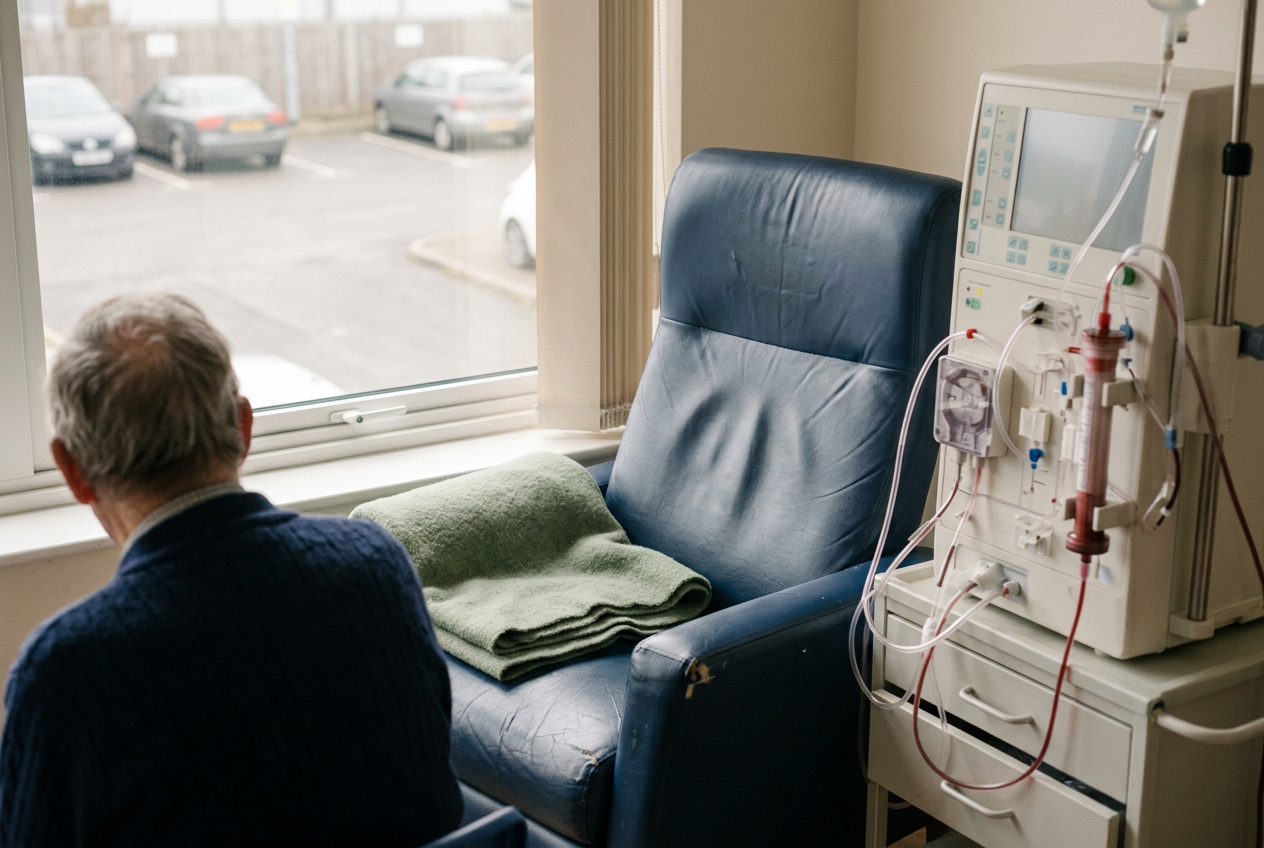
This recliner squeaks under her weight whenever she shifts. The pump starts clicking early in the session so that four hundred milliliters of blood per minute can pass through the filter tube to strip out potassium and surplus fluid.
Joan taught elementary school for thirty-four years. Her weekdays once ran on bell schedules and forty-minute modules on oxbow lakes, which means her week feels strange when it breaks into four-hour blocks on Mondays, Wednesdays, and Fridays. The nurse stamps her card before she hangs the lines.
The sound of the morning
Six recliners line the south wall of the clinic, where every chair sits beside a console with tubes that loop liquid through roller pumps. Bleach smells mix with toast from the breakroom.
An older man arrives in his cap before the morning news comes on, and he removes it only when his lines fill. A woman occupies the corner chair with a radio that she presses to her ear. Nurses move between stations. Monitors beep whenever someone flexes a wrist or bends a line against the armrest.
"You learn the machines first," Joan says. "Machine four whistles through its exhaust fan, and machine two thumps."
The geography of the tray table
Her left arm rests on a wedge so that it stays still even though the arterial fistula vibrates under her skin.
The nurse swings the tray table across the chair. The card sits on the upper corner until Joan sets out her tools, which include a pencil, a sharpener, reading glasses, her crossword book, and a thermos. Her fluid limit sits at seven hundred milliliters every twenty-four hours. Every sip counts against the dial.
The trick to four hours in a chair is sitting inside the time so that you never try to beat the clock.
During her first month in 2021, Joan tried sleeping through treatment until she kept waking up with a stiff neck and a clouded head, which made her treat the tray table like her old desk at the school.
She finishes two puzzles before mid-morning so that she can read local histories from the bookmobile. A notebook holds details she writes down from the parking lot outside. She notices a bread delivery van that unloads trays and a nurse who scatters crusts for crows. An older man waits in a hatchback.
The arithmetic of days off
Life outside the clinic is pinned to her kitchen calendar in Stamford. Mondays, Wednesdays, and Fridays belong to the clinic. Tuesdays, Thursdays, and Saturdays belong to her garden.
The session ends with a saline wash. The saline pushes blood back into her body to leave a faint copper taste under her tongue before the nurse unhooks the lines. Joan presses gauze onto the puncture site with her thumb for twenty minutes. She gets home by early afternoon.
Later in the afternoon, fatigue settles into her limbs when her blood pressure drops. "Tuesday is my real day," Joan says. "My blood is clean and I have twenty-four hours before the next session."
She prunes her geraniums before she visits the butcher on Main Street for two lamb chops so that she can cook dinner according to her dietary limits, which means she double-boils diced potatoes to leach out potassium and eliminates tomatoes and dark chocolate. Her pen ticks off Wednesday on the card.
Learning to sit still
When Joan retired in 2018, her quiet home felt unnatural because classrooms of thirty children had trained her ears for noise. Six patients watch the wall clocks, and six dialyzers hum together until the double chime signals the final fluid drawdown phase. Joan packs her pencil into her case. Rain streaks the window glass. She caps her thermos before she places the card inside her bag and waits for the nurse to bring the tape.
Questions people ask
How often did Joan have treatment, and how long did it take?
Joan attended the clinic on Monday, Wednesday, and Friday mornings. Each session lasted four hours, dividing her week into treatment days and the days she considered her own.
How did Joan pass the time during treatment?
She arranged pencils, reading glasses, a crossword book, and a thermos on the tray table. She completed puzzles, read local histories, and recorded small details from the parking lot. She learned to sit inside the time instead of trying to beat the clock.
What was life like for Joan after a treatment session?
She returned home by early afternoon, then often felt fatigue as her blood pressure dropped. On better days, she tended her garden and shopped for food that fit her dietary limits. She double-boiled potatoes and avoided tomatoes and dark chocolate.
One story a day
The story of the day, in your inbox
One health journey each morning — no advice, no alarm, just company for the road.