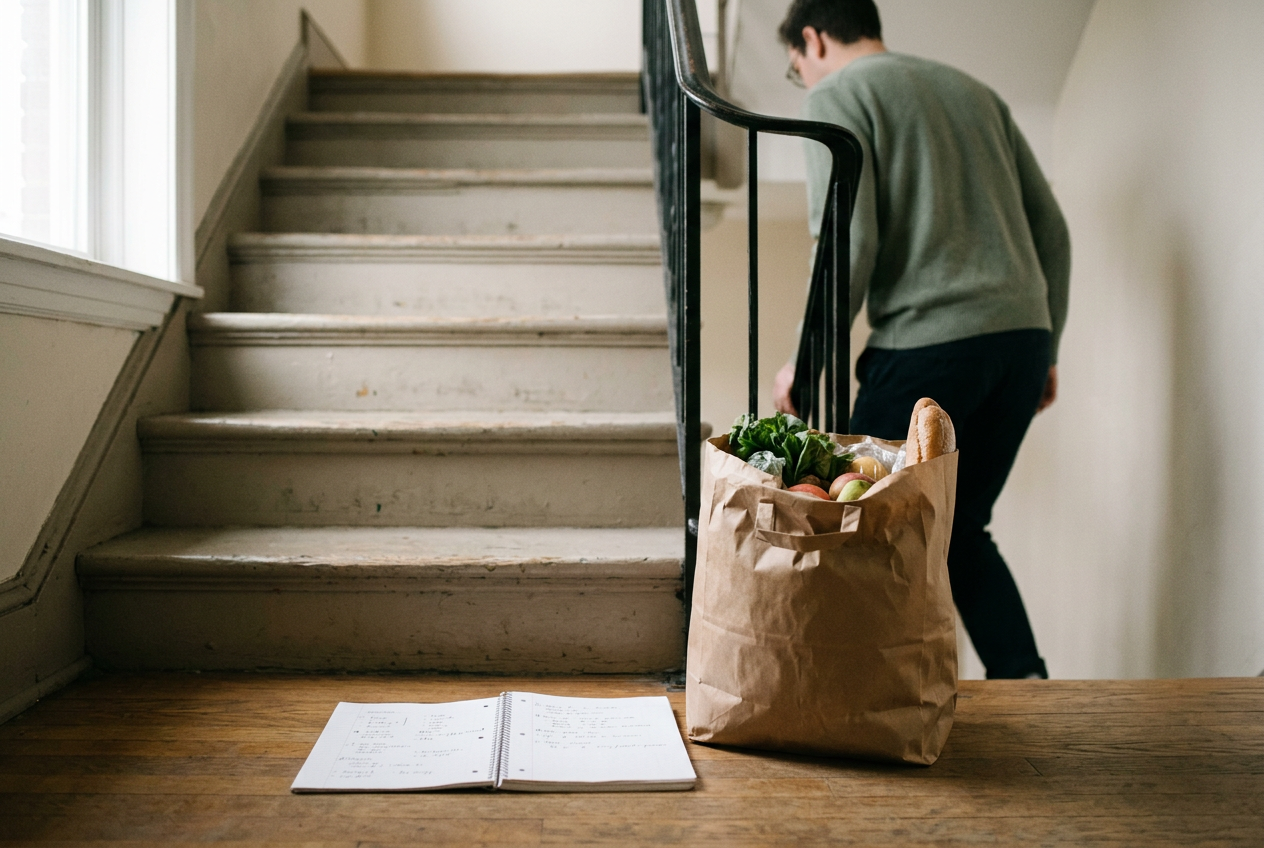
The Arithmetic of the Plate
After a total gastrectomy, eating stops being an unthinking pleasure and becomes a daily exercise in precise timing, volume, and patience.
 Maya EllisonEditor-in-chief & lead narrator
June 29, 2026 · 5 min read
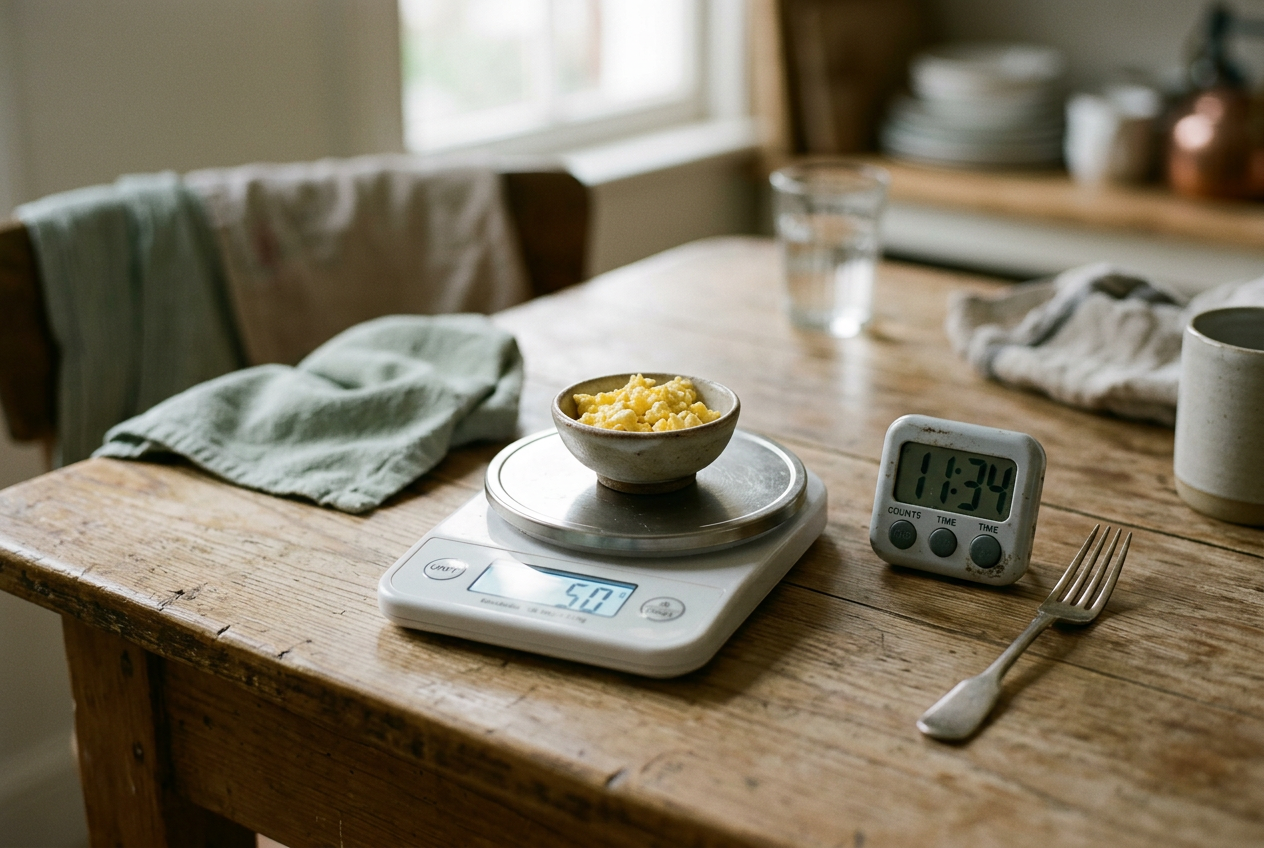
On an early afternoon in October 2023, David sat at his kitchen table. On the table sat a scale and a timer. Next to them was a saucer with fifty grams of cold scrambled egg. Beside his fork lay a notebook.
He was fifty-two years old and six feet tall. His belt was cinched three notches past its original hole.
The timer chimed every twenty minutes. When it sounded, he lifted half a forkful of egg, chewed, and swallowed.
Four months earlier in June 2023, surgeons removed his stomach. They cut out a malignant adenocarcinoma. Where a muscular pouch capable of holding a liter of food once sat, there was now only a direct join between his esophagus and his jejunum.
The body adapts to a change like that. Without a stomach, food no longer rests or churns. It drops straight down. When he ate three bites too many or swallowed too fast, his pulse spiked to 120 beats per minute while his blood pressure dropped to 85 over 50 because fluid rushed into his intestine to dilute the mass.
Doctors called it dumping syndrome.
The conversion of pleasure into numbers
Before the surgery, food was simple. David loved roast beef on Sundays. He bought sourdough from the bakery near the station and drank ale at the tavern. A meal was defined by smell and the warmth it left in his chest.
After the operation, he logged his meals. The notebook stayed beside his plate, open to where pencil lines tracked every bite. Every entry was a sum: protein in grams, fat in grams, fluid in milliliters, hours elapsed since the last swallow.
"If I eat for pleasure, I pay for it in pain," David said. "So I eat for numbers now. Sixty grams of protein by late afternoon. Two hundred calories every two hours."
He could not drink coffee or water with his meals because liquid flushed food through his intestine too quickly, which triggered sweat and nausea so that he had to wait forty-five minutes after his last bite of solids before he took a sip of water. In the first weeks, he spent half his afternoon staring at a glass of tap water on the counter. He watched the timer, waiting for permission to drink.
Sitting at a different kind of table
The hardest part was not the mechanical restriction. It was the isolation at the dinner table. Food is how people gather and make peace.
When his family sat down for Sunday lunch in December 2023 six months after his operation, his wife set a roast dinner before his children while she placed a saucer containing two tablespoons of pureed chicken and a knob of butter in front of David. The smell of gravy filled the dining room.
David looked down at his saucer and wrote "14g protein" into the notebook.
People around him felt uncomfortable. His brother apologized for eating a large meal. His eldest son chewed, staring at his napkin. David told them he was fine.
He was not suffering from watching them eat; he was occupied with the work of his twenty grams.
In restaurants, the friction was worse. Waiters were baffled when a fifty-two-year-old man ordered an appetizer off the kids' menu and asked for it on a plate without sauce. Explaining his missing stomach exhausted him on a Tuesday evening at a neighborhood bistro. He stopped going out to eat for nearly a year.
Relearning the signals
The human brain relies on stretch receptors in the stomach wall to signal fullness. Without those nerves, the body invents new signals. David learned to listen for cues. Fullness no longer arrived as a weight in his midsection.
Instead, it came as a tightness at the back of his throat. A runny nose. A single hiccup.
That single hiccup was his limit. If he ignored it to take another bite, he spent the next hour flat on his back while he waited for intestinal cramps to pass.
Over time, his small intestine stretched to accommodate bulges of food, taking on a fraction of the storage role his stomach once held. After his weight stabilized around 154 pounds, he stopped weighing every piece of chicken on the scale because he developed an eye for what twenty grams of protein looked like on a saucer.
He needed fat. It was a dense source of calories that slowed down digestion. Refined sugar guaranteed an hour of trembling exhaustion. A square of cheddar became regular.
He ate peanut butter on a quarter slice of toast for an afternoon meal.
A different kind of satisfaction
Two years after his gastrectomy, David carries a plastic container of almonds in his coat pocket. He keeps his notebook and a bottle of water beside them. He eats six to eight times a day. He will never sit down to a three-course meal again.
He misses the joy of buying hot fried fish on a freezing afternoon in November. The arithmetic is routine.
On an afternoon in July, he sits in his garden with a bowl of yogurt topped with three blueberries. He chews, sets his spoon on the table between bites, and watches sparrows in the hedge.
Because he must pay constant attention to digest food, he feels no dramatic triumph when he finishes the last spoonful of yogurt, sets the empty bowl on the table, and checks his watch. He does not set a timer.
He waits forty-five minutes, fills a glass with tap water, and takes his first sip.
Questions people ask
How do you eat after having your stomach removed?
David ate six to eight small meals a day, tracking protein, calories, volume, and time between them. He kept liquids separate from solid food, waiting forty-five minutes after eating before drinking. Over time, he relied less on the scale as he learned to judge portions by sight.
How did he know when he was full without a stomach?
Fullness no longer felt like weight in his midsection. David learned that throat tightness, a runny nose, or a single hiccup meant he had reached his limit; another bite could bring an hour of intestinal cramps.
What did dumping syndrome feel like after total gastrectomy?
When David ate too much or swallowed too quickly, food passed directly into his intestine and fluid rushed in after it. His pulse rose, his blood pressure fell, and he experienced sweating, nausea, trembling, or exhaustion. Refined sugar reliably caused problems for him.
One story a day
The story of the day, in your inbox
One health journey each morning — no advice, no alarm, just company for the road.