With 38 Minutes of Concentrator Power Left, Her Niece Called 911
A winter outage cut power to Ruth’s oxygen concentrator. The warming center could not support medical equipment, so her niece tracked the batteries in a notebook until staying home was no longer possible.
 Maya EllisonEditor-in-chief & lead narrator
September 5, 2026 · 7 min read
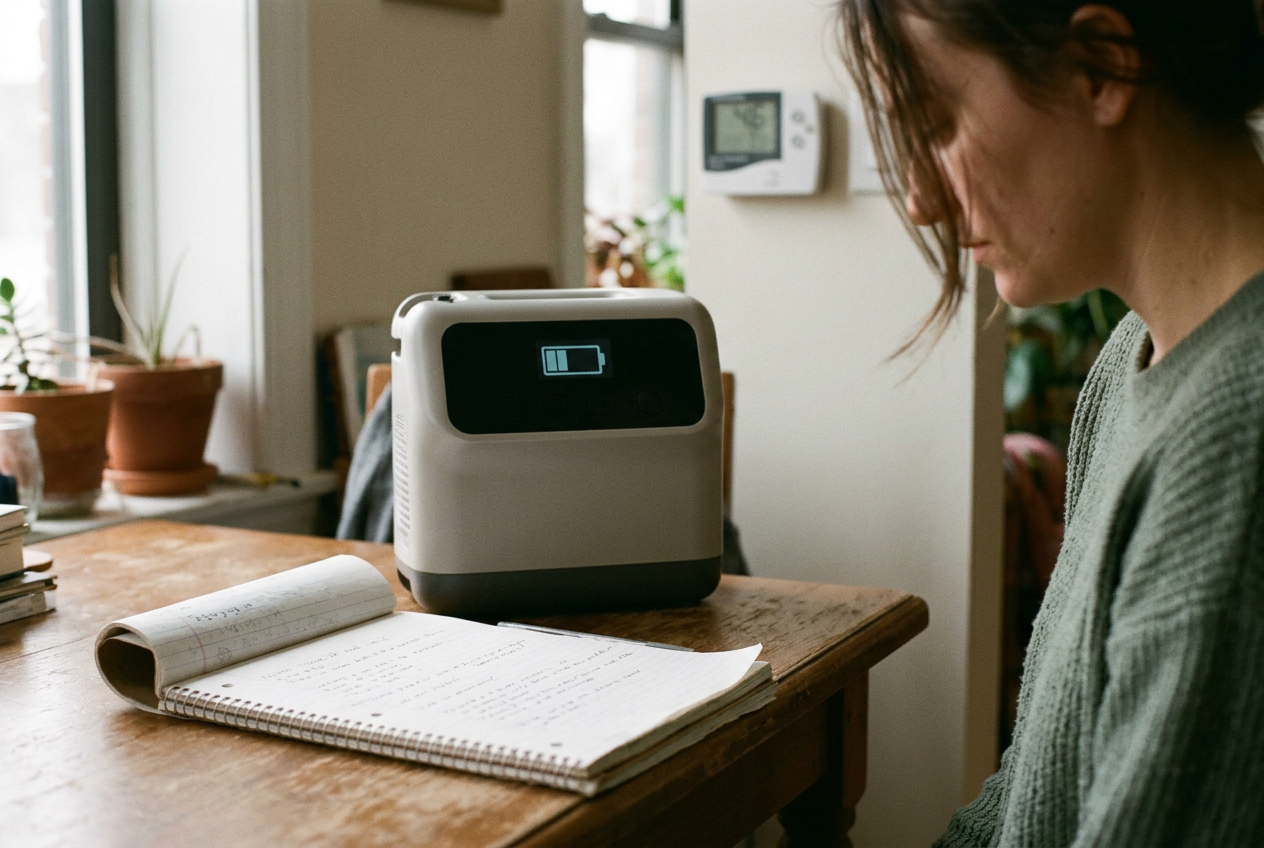
The concentrator stopped humming while Ruth was rinsing her dinner plate. She held still at the sink. Behind her, the furnace fan quit, the kitchen light went dark, and her niece Elena opened the drawer where they kept flashlights.
Elena had come over before the snow started. Ruth, who was 74 and had COPD, rented a small house at the edge of town and usually lived alone. Her oxygen concentrator ran from a wall outlet. For trips outside and power interruptions, she had a portable unit with rechargeable batteries.
The portable unit started with a beep. Elena helped settle the tubing, then reached for the notebook beside the concentrator.
The notebook had become part of Ruth’s oxygen equipment after a summer outage eighteen months earlier. Elena used it to record how long each battery lasted, which ones had been charged, and what happened when the utility went down. One page showed that a full battery had powered Ruth’s portable unit for 2 hours and 11 minutes during ordinary use. Another had lasted 2 hours and 7 minutes.
Those figures were not promises. Ruth’s breathing, the machine’s settings, battery age, and cold weather could change the run time. Still, the notebook gave Elena something firmer than the shrinking symbol on the display.
She wrote down 96 percent for the battery in use. The spare showed 71 percent.
That number stopped her. Ruth had used the spare four days earlier for a medical appointment, and Elena thought it had been recharged. The cable had looked connected. Now she saw that the plug had worked loose from the charging unit.
Ruth sat at the kitchen table wearing her coat. Talking had already begun to cost her more air than usual, partly because she was anxious and partly because cold air made her chest feel tight. She answered Elena in short phrases while the portable concentrator delivered the oxygen prescribed for her.
Outside, snow covered the steps and gathered against Elena’s car. The outage map on her phone showed failures across the county, but no restoration estimate. Ruth’s account carried a medical designation that her primary care doctor’s office had helped document the year before. The utility representative confirmed it was there and explained that it did not guarantee faster restoration during a widespread outage.
Elena wrote that in the notebook too.
The center with no dependable outlet
The county had opened a warming center in a public building about nine miles away. Elena called the information line and explained that Ruth depended on an oxygen concentrator. The center had heat and outlets people could use for phones, but staff could not guarantee continuous power for medical equipment or provide oxygen if Ruth’s batteries failed.
They would not turn Ruth away from the building. They also could not support what kept her safely supplied with oxygen. If the concentrator stopped working, staff would call emergency services.
Elena looked at the snow, the portable unit, and the notebook. Driving nine miles to sit in a building that could not meet Ruth’s medical need made little sense, particularly when roads were worsening and the warming center might lose power too.
The equipment supplier could not bring another charged battery that evening. Delivery vehicles were already delayed. A representative reviewed what Ruth had at home, but there was no overlooked backup tucked into a closet and no nearby branch where Elena could collect one.
The first battery fell through 60 percent. The thermostat in the house read 57 degrees. Ruth kept her coat zipped and a blanket across her legs, though the tubing caught against the fabric whenever she shifted in the chair.
Elena began packing in case they had to leave. She put Ruth’s insurance card and medication list into her purse, then added the charging cable and notebook. She did not pack much clothing. The batteries were the part she watched.
Ruth wanted to wait. Hospitals were tiring for her, and she had spent enough evenings under bright lights answering the same questions about her breathing. She also worried that calling an ambulance during a storm would take help from somebody in worse shape.
For another stretch, staying home still felt possible. The concentrator hummed. The house was cold but not yet bitter. Elena heated canned soup on the gas stove, keeping the kitchen ventilated as Ruth normally did, and they ate without much conversation while the battery display continued to fall.
The notebook filled with percentages. Elena wrote 43, then 28. She left space beside each entry for what they decided, as though the reason might become clearer afterward.
The number that ended the wait
They changed batteries when the first one was nearly depleted. The spare began at 71 percent, just as the notebook said, but its estimated run time dropped faster than Elena expected. Ruth’s hands had become cold. She was breathing with her shoulders raised and pausing between bites of soup.
Elena called the utility again. There was still no estimate.
When the concentrator display showed 38 minutes of remaining power, she called 911. She did not wait for the battery to reach zero. The warming center had already said it could not bridge the gap, the supplier could not reach them, and the house had grown colder while every available battery moved in one direction.
Ruth protested once, then stopped. Elena placed the notebook on top of Ruth’s coat so it would go with them.
Emergency medical workers arrived with oxygen that did not depend on the house current. They checked Ruth in the kitchen, moved her through the snow, and took her to the hospital. Elena followed later, once a neighbor helped clear enough space around her car.
At the hospital, Ruth rested under a warmed blanket while her portable concentrator charged from a wall outlet. She was monitored for worsening breathing and remained there until the household power was back. The outage lasted 16 hours. Ruth spent 13 of them away from home.
The hospital was not part of anyone’s original plan. It became the only place available that could offer dependable electricity and medical support through the remaining outage, even though Ruth did not need hospital care before the power failed.
Elena opened the notebook while they waited. Under 38 minutes, she wrote that emergency services had been called. Then she closed it and slipped it beneath the charging cable.
After the lights returned
The house was warm again when Ruth returned. The stationary concentrator resumed its low hum, and the refrigerator motor started and stopped in the usual way. Melted snow darkened the entry mat.
Over the next month, Elena spoke with the equipment supplier and Ruth’s health plan about an additional battery. The standard equipment was covered, but the extra battery was not. Ruth paid $289, spreading the cost across three months, because the alternative was another evening with no margin beyond what the existing batteries could hold.
Moving was discussed. A larger apartment building nearby had emergency power in shared areas, but rent would have cost $185 more each month, before utilities. Ruth stayed in the house.
Elena also checked warming centers farther away. One could accommodate some powered medical equipment, although transportation during a storm remained uncertain. That address went into the notebook without a promise beside it.
By the next winter, the new battery had its own page. Elena recorded the date it was charged and tested, then placed the notebook back beside the concentrator, where Ruth could reach it from her chair.
Questions people ask
Can a warming center power an oxygen concentrator?
The center available to Ruth had heat and ordinary outlets, but it could not guarantee continuous power or support equipment that a person medically depended on. Capabilities varied between locations, and the nearest building was not a safe substitute for dependable home power or a medically equipped setting.
Does a medical designation guarantee faster power restoration?
For Ruth, the designation told the utility that someone in the home used powered medical equipment. It did not guarantee priority restoration during a countywide outage, and the representative still could not provide an estimate. The notebook preserved that distinction after the call ended.
Why did
Ruth go to the hospital if she was not already in a medical crisis?
Her available concentrator battery showed 38 minutes remaining, the house was getting colder, and neither the warming center nor the equipment supplier could provide dependable power. Emergency medical workers supplied oxygen during transport, and the hospital offered electricity and monitoring until power returned at home.
Did insurance cover another backup battery afterward?
Ruth’s plan covered the oxygen equipment package she already had, but not the additional battery Elena requested after the outage. Ruth paid $289 over three months. Elena tucked the receipt into the notebook on the page where she recorded the battery’s first full charge.
One story a day
The story of the day, in your inbox
One health journey each morning — no advice, no alarm, just company for the road.