His Depression Resisted Treatment. She Kept a 14-Month Log
A notebook helped one caregiver track bills, appointments, and the limits of what she could fix while her partner lived with severe depression.
 Rosa DelgadoNarrator, Caregivers
August 20, 2026 · 8 min read

The notebook began in March 2022, when my partner had been away from work for six weeks and I forgot to pay the electric bill.
Nothing was shut off. I paid the $43 late balance online, wrote PAID across the notice, and put it under a magnet on the refrigerator. Still, forgetting scared me. I had always been the person who knew when the car registration was due and whether we needed detergent.
Now I could stand in the kitchen holding an envelope and lose the reason I had opened it.
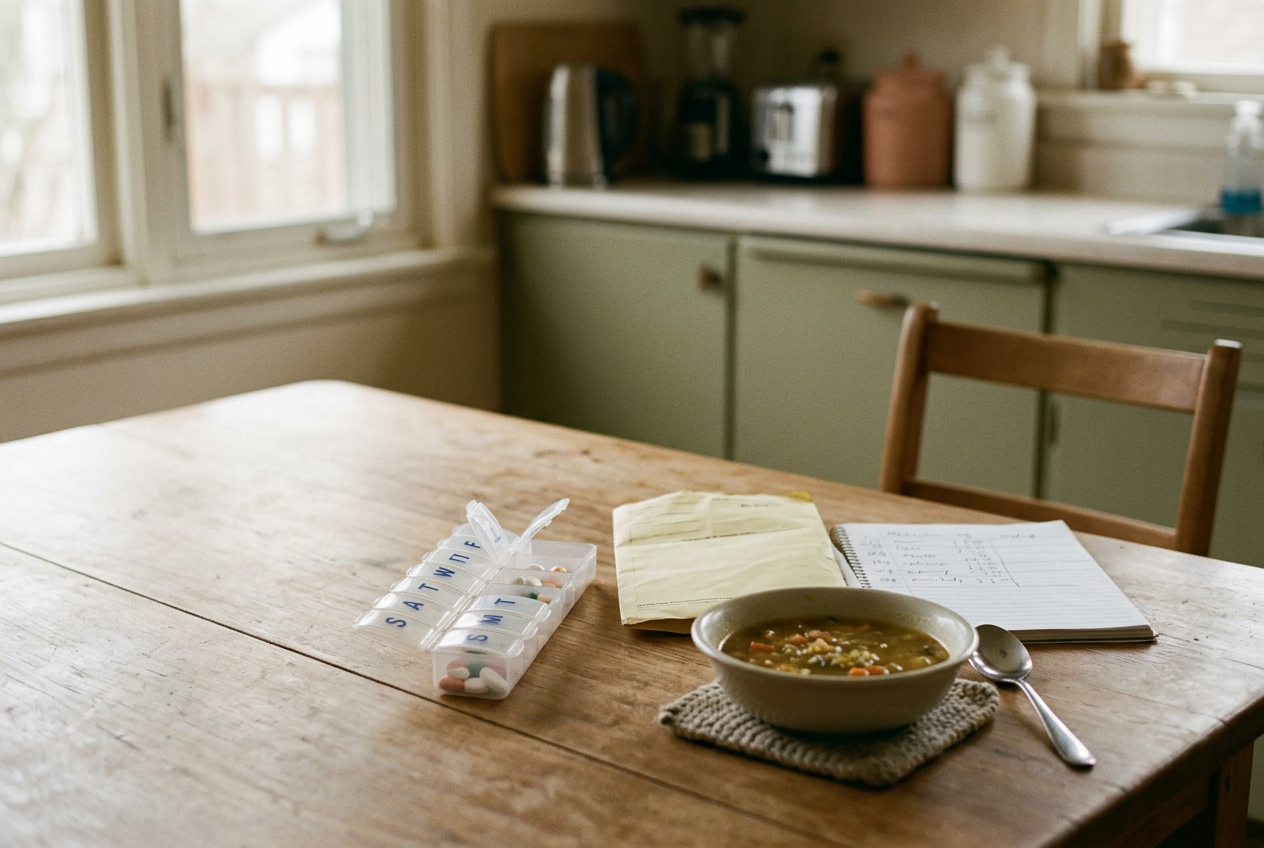
I bought a notebook. On the left page, I wrote bills and household tasks. On the right, I recorded appointments, medication changes described by his doctors, and short notes about what he could manage. I did not write poetry.
I wrote things such as ate some soup, showered after four days, insurance call returned.
By then, depression had reduced his days to very little. Some mornings he got from the bed to the couch. On others he stayed under the blanket while I worked at the dining table, lowering my voice during meetings even though he was behind a closed door. He had been seeing a therapist and a prescribing clinician, and several treatments had failed to bring lasting relief.
Months later, his specialist described the depression as treatment-resistant.
The term did not change the laundry.
The notebook
For fourteen months, the notebook told me what required action. That distinction mattered because everything felt urgent when I held it in my head, including his silence, the empty refrigerator, and an insurance message I could not understand.
We had lived together for eleven years. Before the depression became severe, he cooked more often than I did and dealt with the car. I handled our taxes because he hated the software. Our division of labor was not romantic, but it worked.
Then most of his share became mine, along with the work of watching him struggle and trying not to watch too obviously.
I lowered the household standard. Dinner could be eggs. Clean clothes could remain in a basket. I automated two bills and asked his sister to bring groceries twice a month, which meant I no longer spent part of Saturday walking through the store while answering worried messages from relatives who wanted a progress report.
The notebook also showed the cost. Our checking account dropped to $612 after his disability payments were delayed. A hospital evaluation produced a $1,840 bill that insurance initially treated as our responsibility. I spent six weeks going between the billing office and the number on the back of the insurance card.
The amount was later reduced to $287, which was still money we noticed.
I kept that page folded at the corner. It was the page I returned to when another envelope arrived, partly because it contained the dates of my calls and partly because the reduced balance proved that one concrete problem had changed after I worked on it. His depression did not offer that kind of result.
There were days I resented him for leaving a cup beside the couch while I was carrying the income, the appointments, and most decisions about food. I loved him, and I resented that cup. I sometimes moved it with more force than necessary, then felt ashamed because he was ill and because shame was apparently another household item I had agreed to manage.
He noticed more than I thought. Once, he apologized for being expensive. I told him the bill was not his fault, which was true, but I did not tell him how frightened I was by the money or how angry I felt at having to sound calm. He already believed he was a burden.
Honesty had to be measured against what he could hear, and I did not always know the amount.
Hope without a forecast
At first, I treated every appointment as the possible turning point. I paid close attention to the first days after a treatment changed. If he ate breakfast, I became hopeful. If he went back to bed, I decided hope had been foolish.
That cycle exhausted me. It also made him feel observed. His ordinary bad mornings became evidence in a case neither of us wanted to be arguing.
Around month eight, I stopped asking myself whether the newest treatment would work. His clinicians were still responsible for discussing treatment with him, and he continued making those decisions when he could. My task was narrower: getting us through the week without turning every meal or shower into a prediction.
I began marking plans in the notebook that had nothing to do with his condition. I attended my niece’s school concert. I met a friend for lunch once a month, though the first few lunches were mostly me checking my phone beneath the table. These plans did not make me cheerful.
They gave me events that were allowed to happen even if his symptoms had not improved.
Hope changed from confidence about his recovery to a willingness to leave some future plans on the calendar. That may sound modest. It was modest.
My partner could not always share that hope, and I stopped requiring him to. When he said he could not imagine feeling better, I no longer answered with a speech about the next appointment. Sometimes I sat with him. Sometimes I washed the pan because I needed to do something that ended.
The notebook became less emotional during this period. Earlier pages contained exclamation points beside small improvements. Later pages were plain: refill requested, disability paperwork sent, slept most of day. I was not less invested.
I was trying to stop using his symptoms to regulate my own expectations.
When my attention changed
My fatigue did not arrive as one dramatic collapse. I became irritated when the microwave beeped. I reread work emails without understanding them, then stayed awake worrying that I had made mistakes. During one appointment, his specialist asked how I was managing, and I said fine so quickly that both of us heard the answer for what it was.
A month later, I told my primary care doctor that I was sleeping poorly and having trouble concentrating. She asked about the caregiving load rather than treating it as a side note. I later began speaking with a therapist of my own, where I could say that I was angry without having to add, immediately, that my partner was suffering more.
I also stopped being the family information desk. With his agreement, I sent one update to relatives every few weeks. If there was no news, I said there was no news. This removed a surprising amount of labor, because concern can be loving and still create messages that someone has to answer.
One friend learned to offer specific help. She brought dinner and sat in the kitchen while I put half of it away. She did not ask me to explain whether the week had been better. We talked about a plumbing repair in her house.
I was grateful for ten minutes in which depression was not the main fact about me.
There were still periods when I monitored him closely because his safety was in question. During those stretches, his clinicians and crisis services were involved, and the notebook held the information I could reliably provide. I wrote what had changed and what he had told me in his own words without trying to translate it into medical language.
The notebook could organize information. It could not make me the right person to assess every risk, persuade him to feel differently, or carry a clinical responsibility I did not have. Recognizing that limit did not make the situation easy. It reduced the number of impossible jobs I assigned myself.
Ten months after I started the notebook, he began having occasional afternoons when he could make food or walk around the block. Improvement did not proceed neatly. A better week could be followed by one in which he barely spoke, and I learned not to announce either period as the answer.
He eventually returned to work on a reduced schedule after fourteen months away. I kept managing more of the household than before. Some responsibilities came back slowly; others remained mine without discussion, which I still resent on certain days.
The notebook now sits in a kitchen drawer with takeout menus and spare batteries. I open it when an old bill resurfaces or when I need the month of a past appointment. The final pages have empty space.
Questions people ask
How can one person manage the household when a partner is severely depressed?
In this story, the caregiver used one notebook to separate urgent tasks from work that could wait, lowered her standards for meals and laundry, and accepted specific help from family. The notebook did not reduce her partner’s symptoms. It reduced the chance that a bill or appointment would disappear inside her fatigue.
How can a caregiver keep hope when treatments have not worked?
Her hope became less dependent on predicting the outcome of each treatment. She kept a few personal plans on the calendar and let clinicians handle treatment discussions with her partner. That allowed her to acknowledge his bad days without treating each one as proof that nothing could change.
Can caregiving for a depressed partner affect the caregiver’s health?
She experienced poor sleep, trouble concentrating, and irritability after months of carrying more household and emotional work. She described those changes to her primary care doctor and later spoke with her own therapist. The story does not establish a diagnosis, but it shows why her fatigue became part of the healthcare conversation.
What information was useful during appointments and insurance calls?
She recorded the month of treatment changes, major shifts in daily functioning, and the dates of insurance conversations. That kept her from reconstructing difficult weeks from memory. On the folded page about the hospital charge, the $1,840 balance is crossed out, and the receipt for the $287 payment remains tucked inside.
One story a day
The story of the day, in your inbox
One health journey each morning — no advice, no alarm, just company for the road.