Parkinson’s Made His Chisels Unsteady. He Rebuilt the Shop.
A woodworker changed his tools, teaching space, and designs after Parkinson’s disease altered his fine motor control. A notebook kept track of what still worked.
 Maya EllisonEditor-in-chief & lead narrator
August 20, 2026 · 7 min read
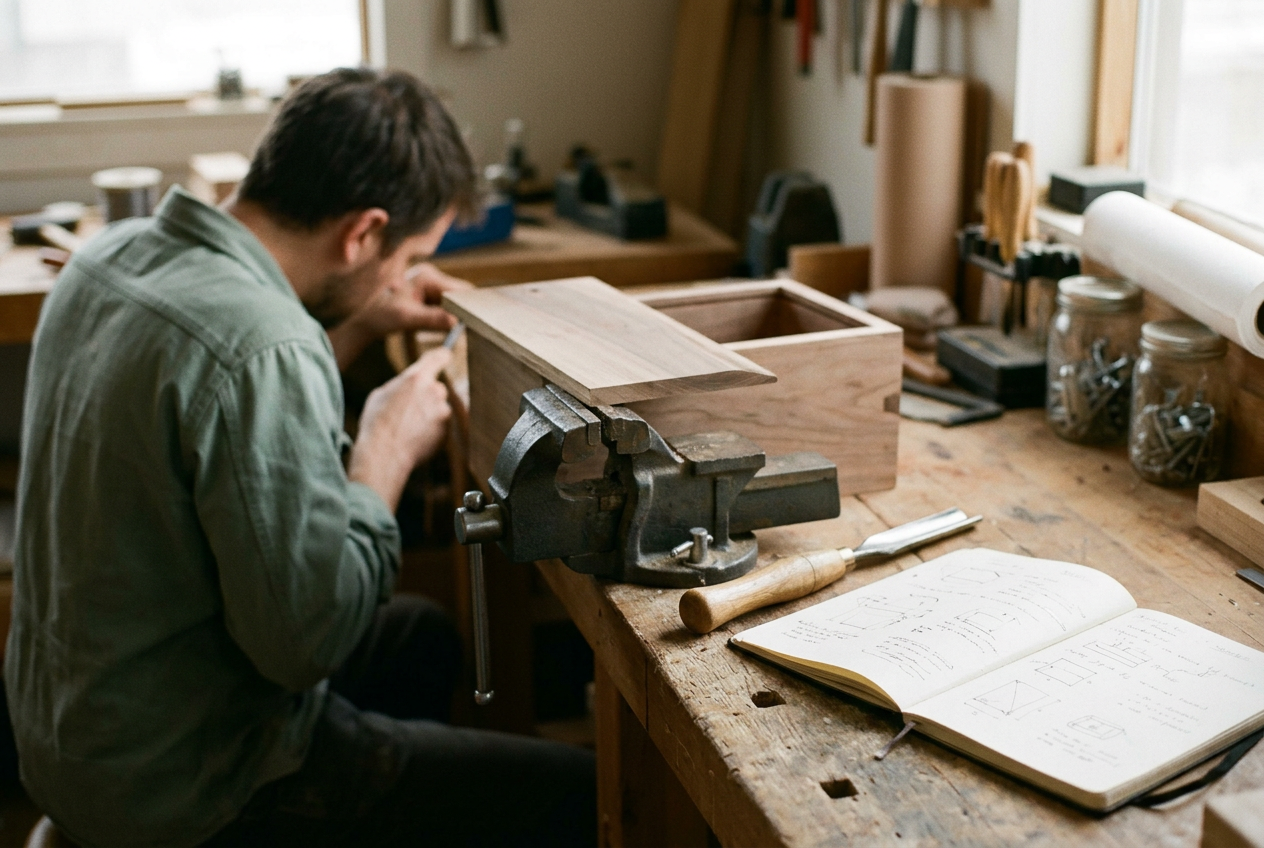
The gouge crossed the pencil line and left a shallow cut in the lid. He put the tool down, opened the notebook beside his vise, and wrote the date under the name of the project. The letters grew smaller as his hand tightened. Beneath them, he added two words: “Clamp earlier.”
It was June 2021, eight months after his specialist confirmed Parkinson’s disease. The notebook had already become part of the bench, as necessary to him as the sharpening stone, though it held no sketches worth keeping and no polished thoughts about craft. He used it to record what happened when he tried to work.
For more than twenty years, his hands had known the order of things. His left hand steadied the wood while his right guided a chisel. A fingertip checked whether a joint sat flush. He could feel a slight ridge without looking, correct it, then move on.
That had started to change fourteen months before the diagnosis. A shirt button took longer. His handwriting crowded itself. At the bench, his right hand sometimes paused before a cut, while on other days a tremor appeared just as the edge met the wood.
The changes did not arrive together or stay the same, which made them easy to dismiss and hard to plan around.
The notebook began in January 2020. He dated each project and wrote down what his hands did, along with the parts he had to remake. One early page says that a fitted drawer needed another morning. A later entry records a box lid cut twice because the first one no longer met his standard.
He did not begin the notebook to document illness. He thought he was having a poor run of work.
The first redesign
After the diagnosis, he spent three months trying to preserve the shop as it was. The bench stayed where it had always been. His chisels kept their narrow handles, and he continued cutting small joints by hand because that was how he had learned to judge his own skill.
The effort wore him out. A box that once took five days took eleven, and the extra time did not come from the construction alone. He rested between steps, swept up more often to reset his attention, and sometimes stopped after a gouge slipped even when the mark could be repaired.
The first consequential change was a vise that could hold work in more positions. It reduced the amount of pressure he needed from his left hand, which had grown stiff, and let him use both hands on a tool when the cut allowed it. He wrote the result in the notebook after finishing a small tray: “No chasing the wood.”
He also fitted larger grips to the tools he used most. The change bothered him. For years, he had shaped handles so they disappeared in his hand, giving his fingers a close sense of the cutting edge. The thicker grips felt blunt at first, but they asked less of his fingertips, and after six weeks he stopped removing them when he wanted to attempt delicate work.
His shop changed around those decisions. Frequently used tools moved into open reach above the bench rather than inside drawers. He added brighter task lighting and cleared the narrow space beside the vise, where an offcut on the floor could interrupt a step that was already slower than it used to be.
None of this produced the old control. It gave him more chances to begin a cut in a stable position, and that distinction mattered on days when his right hand was slow but not shaking, because he could still work if he stopped expecting the movement to happen automatically.
The notebook tracked those days without explaining them. A maple box went well across two mornings. A walnut lid did not. On another page, he crossed out the name of a planned piece and wrote, “Too much inlay,” then left the rest blank.
That empty space stayed with him. Inlay had been part of his work for years. He liked the concentration it required and the clean boundary between pieces of wood, especially when a narrow channel closed around the inserted strip with no visible gap. By late 2021, the repeated small cuts had become difficult enough that he stopped offering inlay on commissions.
He did not announce the change. He revised the photographs he showed prospective customers and began presenting boxes with carved lids instead. A few previous clients asked for the older detail. He declined those orders or offered another design, which meant giving up work he once would have accepted without hesitation.
Changing the classes
Teaching required another redesign. His weekend workshops had depended on close demonstrations, with students gathering around the bench while he cut a joint and described what he could feel through the handle. A tremor during one class caused the chisel to catch. No one was hurt, but he ended the demonstration and spent the next week deciding whether he could keep teaching.
For six months, he canceled classes.
When he resumed, the room looked different. A camera above the bench sent a close view to a screen, so students could remain at their own workstations while he demonstrated. He prepared some stock ahead of time, leaving enough material for students to make their own cuts without requiring him to repeat the smallest setup throughout the day.
The classes changed in tone as well. He no longer built the day around a finished object that everyone would carry home. Students practiced a joint, fitted it, then made a second version if time and attention allowed. He could sit for parts of the demonstration, and if his hand would not settle, he showed the setup on a prepared piece rather than forcing a live cut.
He disliked that accommodation more than the larger tool handles. Teaching had been the place where his movements looked most certain, and the new format made preparation visible where fluency had once been enough. Still, the camera let students see the tool edge better than they had when they crowded the bench. That fact was useful.
It did not make the loss disappear.
Parkinson’s disease did not give his workdays a dependable shape. He noticed stretches when his movements felt easier after taking his prescribed medication, but those periods varied, and he did not build promises around them. For commissions, he doubled his estimated time and limited the number of pieces underway.
One customer waited fourteen weeks for a keepsake box that he had expected to finish in eight. The first lid warped. The replacement carried two cuts outside the marked curve, both shallow enough to remove, but he set it aside anyway and started again. In the notebook, the project filled most of a page.
The final box was clean. He did not feel satisfied by that in the way he once would have. What stayed with him was the discarded lid leaning beneath the bench, because it showed how much wood and concentration could be consumed by a standard that had not changed while his hands had.
Over the next year, he began making larger pieces with broader carved marks. He used a clamped guide for repeated cuts and left some shallow tool marks where he previously would have sanded them away. The decision was practical at first. Removing every mark took longer and placed more demand on the same movements that had caused it.
Then customers began choosing those pieces. He did not treat that response as proof that Parkinson’s had improved his work. Some days, he still opened an older box and ran a finger over the inlay, checking a level of precision he could no longer promise. Other days, the new carving held his attention without comparison.
The notebook changed too. Early entries recorded mistakes. Later pages included setup notes, such as which clamp position reduced strain and which handle allowed him to keep both hands involved. In March 2023, he returned to the June 2021 page with the crossed pencil line and added a second note beneath “Clamp earlier.
” It read, “Made lid wider.
That lid became the pattern for a workshop project. The curve was broad enough to cut with two hands on the gouge, and the wider edge gave students room to adjust without losing the shape. He kept one finished example near the screen during class. The original, with its shallow cut beyond the line, remained under the bench.
Questions people ask
Can someone keep woodworking after Parkinson’s changes fine motor control?
In this account, the woodworker continued by changing the work rather than trying to reproduce every old movement. He used more stable setups, accepted longer timelines, and stopped offering details he could no longer complete consistently. His ability still varied from one day to another.
Which workshop changes made the biggest difference for him?
The repositionable vise and larger tool grips changed how much his fingers had to do. Moving tools into easy reach also reduced interruptions between steps. These were personal adjustments recorded through repeated projects, not a universal setup for every woodworker with Parkinson’s disease.
How did
Parkinson’s change the classes he taught?
He replaced crowded, close demonstrations with an overhead camera and prepared some material in advance. Students practiced techniques without depending on him to complete every delicate cut in front of them. The revised format also gave him room to sit or switch to a prepared example.
Did he give up detailed woodworking?
He stopped taking commissions with narrow inlay and moved toward larger carved forms, though he still kept examples of his earlier work. Some unfinished pieces stayed in the shop as well. Beneath the bench sat the first widened lid, and beside the vise the notebook remained open to its revised pattern.
One story a day
The story of the day, in your inbox
One health journey each morning — no advice, no alarm, just company for the road.