A Second Lab Changed the Words on Her Tumor Report
A family waited 12 days after a second laboratory revised the wording on a tumor report. The change came from another slide review and added stains, not automatically from a careless mistake.
 Priya RamanNarrator, Plainly Put
August 23, 2026 · 8 min read
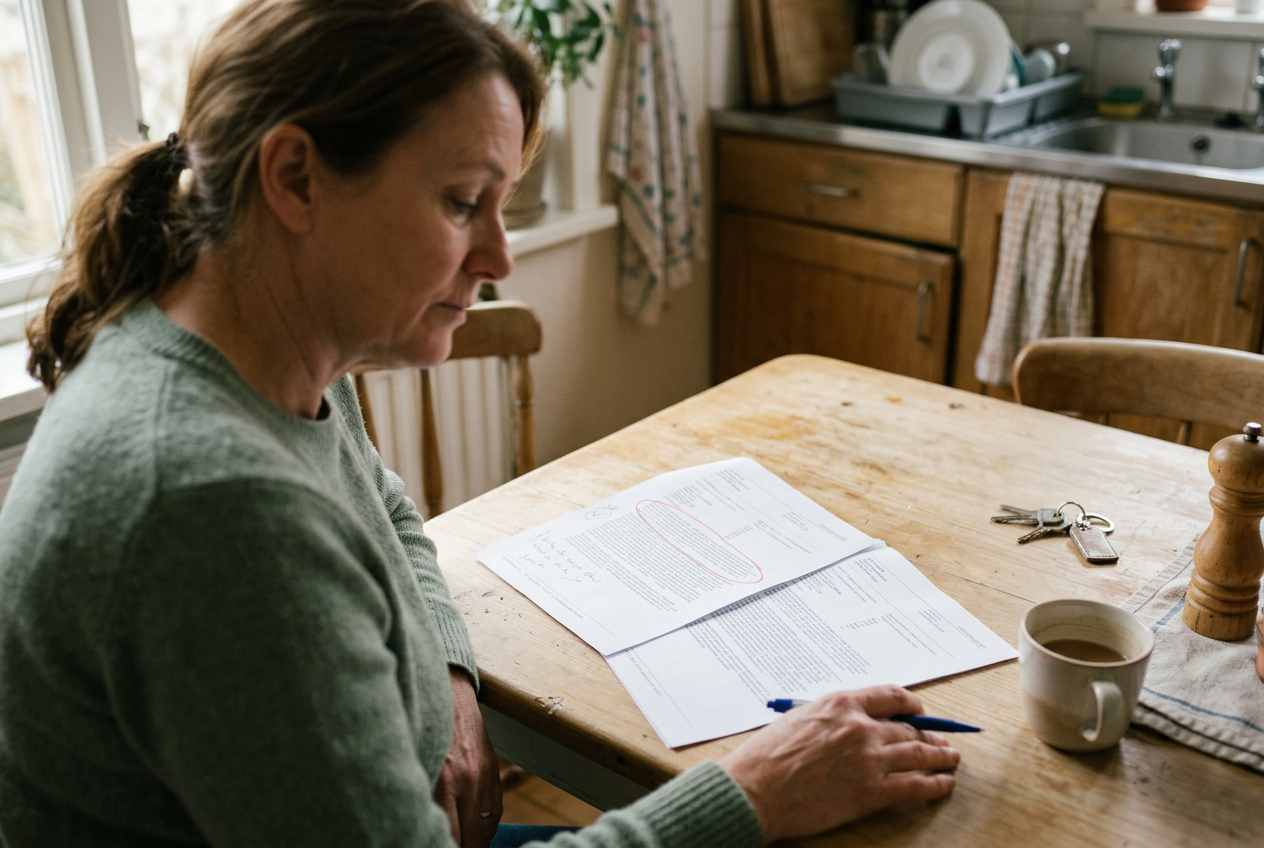
The line that stopped Mara’s family appeared near the top of a pathology report in her patient portal: “revised interpretation.”
She printed the report. It was two pages long, and the new wording describing her tumor did not match the wording on the first report from three weeks earlier. The first laboratory had placed the tumor in a broad category. The second described features that pointed toward a more specific type of cancer.
Her specialist had requested the second review before settling on a treatment plan. Mara knew that. What she had not expected was for the diagnosis section to change.
For 12 days, while the medical team waited for another laboratory test, the two-page report stayed on her kitchen table. Her family read the changed paragraph repeatedly. One person saw evidence that the first laboratory had missed something. Another worried that the second laboratory might be wrong.
Mara kept returning to the phrase “revised interpretation,” which sounded final even though the report itself said more work was underway.
That confusion is common. A pathology report is an expert medical interpretation of cells and tissue, not a reading produced by a machine with only one possible answer. A second interpretation can add detail, narrow the possibilities or, less often, disagree in a way that changes the diagnosis.
What the pathologist is reviewing
A biopsy is a procedure that removes cells or tissue from the body for examination. The removed material is called a specimen.
At the laboratory, staff preserve the specimen and usually place small pieces into paraffin wax, which creates blocks that can be stored. Very thin sections are cut from those blocks, placed on glass slides and stained so that cell structures can be seen under a microscope.
A pathologist is a physician who diagnoses disease by examining specimens and interpreting laboratory findings. For a tumor, the pathologist studies details such as how the cells are arranged and how different they look from the nearby tissue. The report may describe whether the sample is cancerous, what kind of tumor it appears to be and which findings remain uncertain.
When Mara’s case went for a second review, the second laboratory did not begin with a new biopsy. It received selected glass slides and tissue blocks from the first laboratory, along with the original report and clinical information supplied by her care team.
Another pathologist then examined the material. That review was more than proofreading. The reviewer looked at the tissue directly and decided whether the visible features supported the original interpretation, whether the tumor could be classified more narrowly and whether additional testing might help.
The same slide can carry more information once a pathologist approaches it with a different question, particularly when the first report was produced before imaging results or other parts of the medical record were available. Context does not replace what is visible under the microscope, but it can help the pathologist decide which possibilities deserve further testing.
Why added stains can change the wording
The routine stain used on most tissue slides shows the broad structure of cells and tissue. Some tumors remain difficult to identify from that appearance alone, especially when the cells have lost many of the features that usually reveal where they came from.
A laboratory may then use immunohistochemistry, often shortened to IHC. This is a method that applies antibodies to a tissue section to look for particular proteins. The pattern of positive and negative results can support one tumor category over another.
No single stain necessarily settles the matter. Pathologists interpret a group of results alongside the tumor’s appearance and the patient’s clinical information, and some markers occur in more than one kind of cancer. The wording may stay broad until enough pieces agree.
That was the reason for the 12-day wait in Mara’s composite story. The second pathologist requested added stains from material in the stored block. The first report had not ignored those results; those particular tests had not yet been performed.
When the updated report appeared, Mara circled the added-stain section on her printed copy. Several lines recorded whether the tumor cells showed the proteins being tested. Below them, the revised diagnosis used more specific language than the original report.
Additional testing can also produce an inconclusive result. A specimen may contain too few tumor cells, tissue can be damaged during collection or processing, and a marker pattern may not fit neatly into one category. In those situations, the report may use cautious terms because the evidence remains limited.
Different wording can reflect a real difference
Pathology contains judgment. That does not mean a pathologist is guessing.
Some findings are straightforward and produce strong agreement among reviewers. Others sit near the boundary between categories, involve an uncommon tumor or depend on distinctions that have changed as medical knowledge has developed. A specialist pathologist who focuses on tumors from a particular part of the body may also have more experience with an unusual pattern.
Reports can differ without contradicting each other. One may say “carcinoma,” meaning a cancer that begins in cells lining an organ or body surface, while another adds a likely site or subtype. One laboratory may state that a feature is present; another may describe how strongly it appears. The second version can be narrower while preserving the central conclusion that the sample contains cancer.
Sometimes there is a meaningful disagreement. One reviewer may classify a tumor differently, assign a different grade or conclude that the tissue does not show cancer. Grade describes how abnormal tumor cells look and can help a care team understand likely behavior, although its meaning varies by cancer type.
Errors can happen in pathology, as they can elsewhere in medicine. A slide can be mislabeled, an important area can be missed or a finding can be interpreted incorrectly. Yet changed language alone does not establish that an error occurred. The reports, slides, added tests and clinical context have to be compared.
That distinction mattered to Mara’s family. The second report did not say that the original reading had been careless. It explained that the review, together with the added staining pattern, supported a more specific interpretation.
What a revision can change
A revised pathology interpretation may affect treatment when different tumor types respond to different therapies. It may also influence whether the care team seeks more testing or discusses surgery, radiation or drug treatment.
In other cases, the revised words do not alter the plan. The change may clarify terminology, record a specialist’s agreement or add detail that matters to the medical record but not to the next step in care.
Mara’s specialist waited for the completed review before discussing the plan in detail. That delay felt alarming to the family, although the purpose was to avoid building a plan around information that was still being refined. Once the added results arrived, the specialist explained which part of the diagnosis had changed and which part had not: both laboratories agreed that the specimen contained a malignant tumor, meaning cancer, while the second report classified it more specifically.
A report by itself cannot tell a reader how much a wording change matters for one person. It also cannot establish which interpretation is best without access to the slides, the full record and the pathologists’ reasoning. The treating cancer specialist can explain whether the revision affects care, while questions about how the tissue was interpreted may be relayed to the pathologist through the medical team.
Mara wrote the explanation in the margin of the printed report. She did not cross out the first diagnosis. Both remained part of the record.
The reports do not erase each other
After a second review, a laboratory may issue a consultation report, an amended report or an addendum. An addendum adds information without necessarily changing the original diagnosis. An amended report corrects or revises something already reported. Laboratories use these terms according to their own policies, so the heading alone may not reveal how important the change is.
The care team generally receives the second interpretation and considers it with the rest of the case. If the difference could alter major decisions, the pathologists may discuss the slides, more material may be reviewed or another expert opinion may be sought. That process can take days or weeks because physical slides and blocks may need to move between laboratories and added tests need tissue and processing time.
The waiting period ended for Mara, but one thread did not. Her family still wanted a clean answer about which report had been “right” from the beginning. The record offered something less tidy: an initial interpretation based on the available work, followed by a more specific interpretation after specialist review and added staining.
Questions people ask
Does a changed pathology report mean the first laboratory made a mistake?
No. A change may follow review by a pathologist with different expertise, new clinical information or added stains that were not available for the first report. Errors are possible, but deciding whether one occurred requires comparison of the specimen, test results and reasoning, not the revised wording alone.
Does the second laboratory receive the whole tumor sample?
Often it receives glass slides, tissue blocks or both, depending on what was requested and what material remains. The second pathologist may review the submitted slides or ask for more sections to be cut from a block. A new biopsy is not automatically part of a pathology review.
Can a second pathology review delay cancer treatment?
It can add days or weeks while material is transferred, reviewed and tested. In Mara’s case, the added wait was 12 days. Whether that interval matters medically depends on the cancer and the planned care, which the treating specialist is positioned to explain from the full record.
Will the original pathology report disappear from the record?
Usually the original report remains, with an addendum, amendment or separate consultation report showing what changed. Portal displays vary, so the relationship between documents may be hard to see. Mara kept both printed reports together, with the added-stain section circled and her specialist’s explanation written in the margin.
One story a day
The story of the day, in your inbox
One health journey each morning — no advice, no alarm, just company for the road.