Her Baby’s 18.1 Bilirubin Result Led to Blue-Light Treatment
A parent saw a high bilirubin result and wondered how light could help. The answer lies in blue wavelengths that change bilirubin into forms a newborn can remove.
 Priya RamanNarrator, Plainly Put
September 4, 2026 · 8 min read
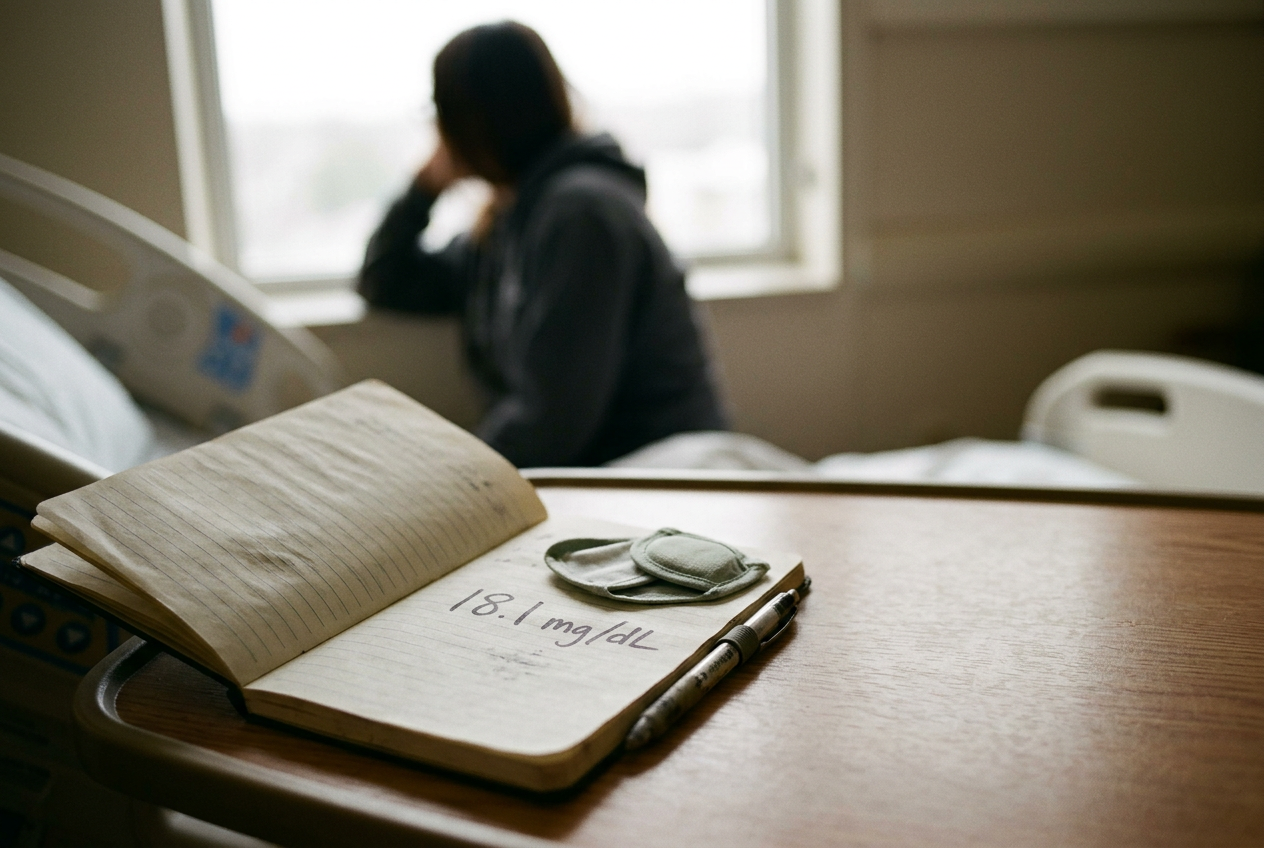
The number in the parent’s notebook was 18.1 mg/dL. It had been copied from the baby’s online lab result four days after birth, with “high” beside it and “blue light” written underneath.
The number measured bilirubin, a yellow substance produced when the body clears old red blood cells. The unit, milligrams per deciliter, describes how much bilirubin was found in a set amount of blood. None of that told the parent why a lamp could change it.
In this composite account, the newborn had looked more yellow that morning, first around the face and then across the chest. A clinician examined the baby, reviewed the blood result and recommended phototherapy, which means treatment with light.
The parent pictured an ordinary lamp. Phototherapy is more precise than that. It uses a controlled band of blue or blue-green light, usually delivered by light-emitting diodes, or LEDs, positioned over or around the baby. The treatment does not cut the skin or place medicine into the body, though blood samples are still commonly used to measure bilirubin.
Where the yellow color comes from
Newborns replace red blood cells quickly. When those cells are cleared, part of their contents becomes bilirubin. An adult liver usually processes bilirubin into a form that can leave through bile and stool, but a newborn’s liver is still developing and may not keep pace during the first days after birth.
Bilirubin can then collect in the blood and move into body tissues, including the skin. That produces the yellow color called jaundice.
Some jaundice is associated with the ordinary transition after birth. Higher or rapidly rising bilirubin can also be connected with premature birth, difficulty taking in enough milk, bruising from delivery, differences between a parent’s and baby’s blood types, infection, or conditions that cause red blood cells to break down faster. Clinicians look at the whole picture because the same lab value does not mean the same thing for every newborn.
The 18.1 in the notebook mattered, but it was not a complete answer. Treatment decisions also depend on the baby’s age measured in hours, gestational age at birth, current health, risk factors and the pattern of earlier results. A value that leads to phototherapy for one baby may be handled differently for another.
This article cannot determine whether any individual bilirubin result requires treatment. A pediatric clinician who can examine the baby and review the full record is the person who can interpret that result.
Why blue light works
Light travels in wavelengths. A wavelength is the distance between repeating peaks in a light wave, measured in nanometers. One nanometer is one-billionth of a meter.
Phototherapy devices commonly concentrate light in a blue to blue-green range around 460 to 490 nanometers. Bilirubin absorbs light especially well within this range, which is why the color matters. White room light contains many wavelengths, while a phototherapy device puts useful light where it can reach exposed skin at a measured intensity.
When a particle of light, called a photon, reaches bilirubin in the skin, the absorbed energy changes the molecule. This is often described as breaking bilirubin down, but much of the work is closer to rearranging it.
One change produces temporary configurations of the bilirubin molecule that can move through the body more readily. Another produces lumirubin, a water-soluble structural form that can be excreted without going through the liver’s usual processing step. A smaller amount undergoes photo-oxidation, in which light and oxygen help create additional products the body can remove.
The practical result is that transformed bilirubin can leave in urine or bile more easily. The light does not pull jaundice out through the skin, and it does not make the liver mature faster. It gives the body another route for handling bilirubin while clinicians watch the level and the baby’s condition.
The parent returned to the notebook and drew a line from “blue light” to “changes the shape.” That was easier to hold onto than the chemistry.
The work of skin exposure
A baby receiving phototherapy usually wears only a diaper so that more skin can receive light. The eyes are covered with protective shields because the treatment is intended for the skin, not the eyes.
How much light reaches the baby matters as much as its color. Clinicians call the delivered light energy irradiance. Pediatric nurses may check irradiance with a meter, confirm that the equipment is placed according to its specifications and make sure blankets or clothing are not blocking the treatment area.
The treated surface area matters too. Some setups shine from above. Others use a lighted pad or wrap that rests near the baby’s skin, and some babies receive light from more than one direction. The choice depends on the bilirubin level, the device available and the clinical setting.
Parents may hear staff talk about “intensive” phototherapy. In this context, intensive does not mean painful or surgical. It refers to providing enough appropriately selected light across a large area of skin, while limiting interruptions according to the treatment plan.
The baby in this account spent 14 hours under LED lights, with breaks handled by the care team around feeding and routine care. The parent sat nearby with the notebook open, watching the covered eyes and wondering whether the baby felt the light.
Phototherapy itself is not meant to heat or burn the skin. Babies may still become warmer or cooler depending on the equipment and surroundings, so nurses check temperature. They also observe feeding, wet diapers, stools, skin condition and general behavior, because those details help show how the newborn is tolerating treatment.
What the nurses are watching
Phototherapy can increase water loss through the skin, and some babies have looser or more frequent stools. Temporary skin changes can occur. These observations do not explain why jaundice developed, but they can affect how the team manages feeding, fluids and the treatment environment.
The eye covers receive attention as well. Nurses check their position and remove them for appropriate care and observation. A parent may see the baby repositioned so that light reaches different areas, although the details vary with the device.
Much of the nursing work looks ordinary from the chair beside the bassinet. A temperature is checked. A feeding is recorded. The light is measured.
Yet those actions connect the physics of a particular wavelength with a newborn who still needs warmth, food, sleep and contact with a parent.
The notebook gained another line: “repeat blood test.” Phototherapy can lower bilirubin in the skin before the yellow color visibly fades, so clinicians rely on blood measurements rather than appearance alone. They consider how quickly the level changes and may repeat testing after treatment stops, particularly when they are concerned about rebound, meaning that bilirubin rises again.
A repeat test after 14 hours showed that the level had fallen enough for the care team to stop the lights. That did not mean every bilirubin molecule was gone. It meant the team judged the result and the baby’s circumstances together, rather than treating the word “high” on the portal as a stand-alone diagnosis.
What blue light cannot explain
Phototherapy handles excess bilirubin. It does not identify the reason bilirubin accumulated.
A clinician may review feeding, weight change, birth history, blood types and other laboratory findings while deciding whether the pattern fits a common newborn transition or needs further investigation. In uncommon cases, jaundice can signal a condition requiring treatment beyond light.
Very high unconjugated bilirubin, meaning bilirubin that has not yet been processed by the liver, can enter brain tissue and cause injury. Phototherapy is used to lower that risk. Some situations require faster or more invasive treatment, which is why the care team pays attention to the baby’s age and condition rather than waiting for skin color alone to settle.
This piece cannot explain the cause of jaundice in a particular baby, predict how long treatment will last or interpret whether a result is safe. Those questions belong with the baby’s pediatric clinician, who has the examination, test history and details of the birth.
Ordinary sunlight is not a controlled substitute for medical phototherapy. Its useful wavelengths vary with windows, weather and positioning, while ultraviolet exposure and temperature are harder to manage. Hospital and home phototherapy devices are designed to deliver measured light, and home treatment is used only in selected circumstances with clinical oversight and follow-up testing.
Questions people ask
Does phototherapy hurt a newborn?
Phototherapy is noninvasive, and the light itself is not intended to hurt or burn the baby. Newborns may be unsettled by being undressed, having their eyes covered or spending time away from a parent’s arms. Nurses monitor temperature, skin, feeding and comfort while the treatment is running.
Why does the baby need blood tests if the skin looks better?
Skin color is affected by lighting and does not show an exact bilirubin concentration. Blood testing lets the care team measure the change, compare it with the baby’s age and risk factors, and check whether bilirubin rises after treatment ends. The heel stick is separate from the light treatment itself.
How long does newborn phototherapy take?
There is no single duration. The care team looks at the starting bilirubin level, the baby’s age and gestational age, how effectively the light is delivered, and the change on repeat testing. In this composite account, the lights ran for 14 hours before the team reviewed another result.
Why can bilirubin rise again after the lights stop?
The baby’s body continues clearing red blood cells after phototherapy ends, while the liver may still be catching up. Some bilirubin can move back from tissue into blood, creating a rebound. Whether another test is used depends on the clinical picture; the parent wrote the follow-up result directly beneath 18.1 in the notebook.
One story a day
The story of the day, in your inbox
One health journey each morning — no advice, no alarm, just company for the road.