Her Surgery Note Said NPO. Even Water Could Change the Plan
NPO means nothing by mouth, but many modern fasting plans treat clear liquids differently from food. The instructions depend on the patient, procedure, and anesthesia plan.
 Priya RamanNarrator, Plainly Put
August 10, 2026 · 8 min read
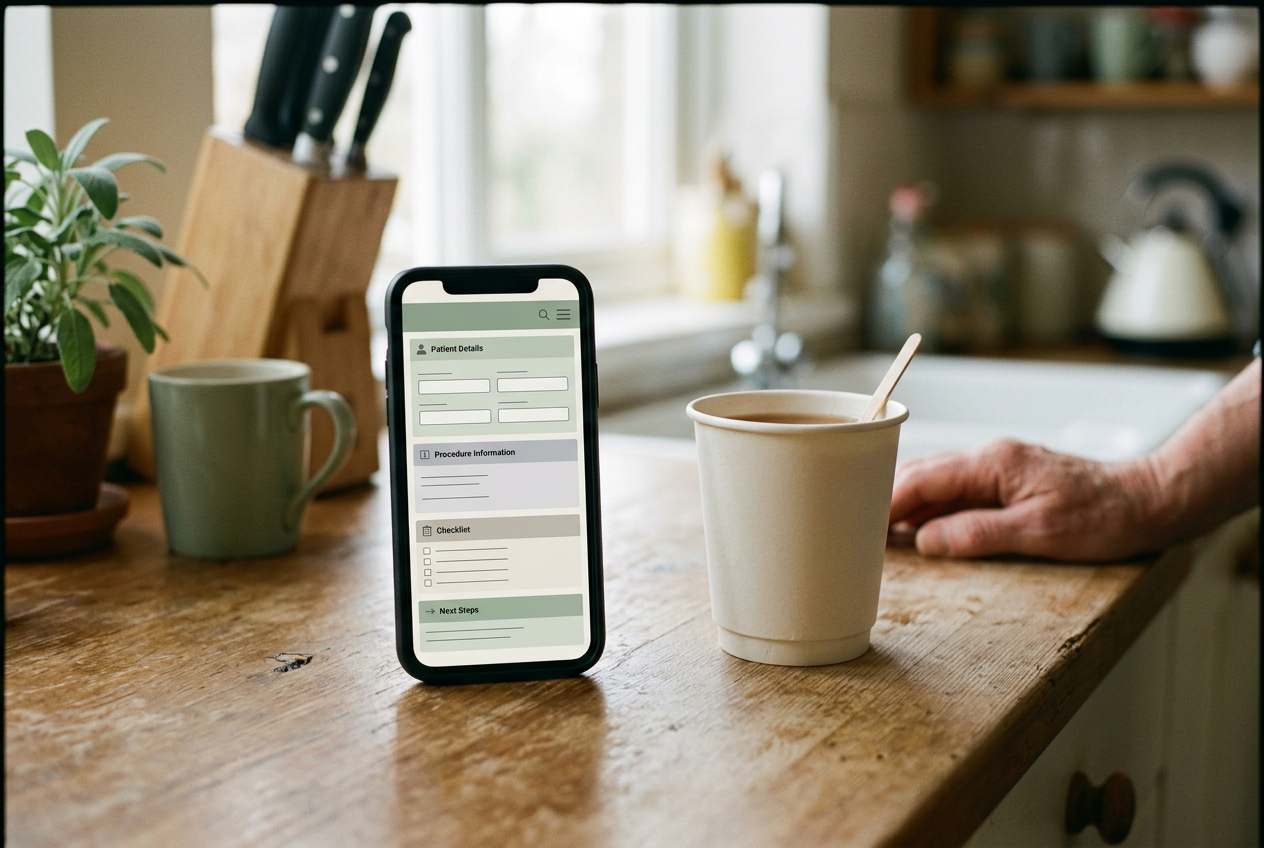
Lena had read the preparation notes for her outpatient procedure twice. One line on the patient portal labeled her status NPO and told her to fast overnight. The abbreviation was unexplained.
She understood that breakfast was out. Water seemed different.
That distinction mattered when she stood at her kitchen counter with a paper cup in one hand and the portal open on her phone. Her mouth was dry. The cup held only a small amount, far less than she would normally drink, and she could not see how it might affect a procedure hours later.
She did not drink it. Later, the preoperative nurse explained that NPO comes from the Latin phrase “nil per os,” meaning nothing by mouth. In a medical instruction, it can include food, water, gum, candy, and anything else swallowed, though a patient’s individual plan may allow certain clear liquids for part of the fasting period.
The portal line had compressed all of that into three letters.
The abbreviation hides the point
Pre-surgery fasting is mainly intended to reduce pulmonary aspiration. Aspiration means material from the stomach enters the airway and lungs instead of remaining in the digestive tract.
Most of the time, the body has several ways to prevent this. Swallowing moves material toward the stomach. The lower esophageal sphincter, a ring of muscle where the esophagus meets the stomach, helps limit backward flow. Coughing can clear material that approaches the airway.
Sedation and general anesthesia can weaken those protections. General anesthesia produces a controlled state of unconsciousness, while sedation reduces awareness to varying degrees. The drugs used may relax muscles and suppress coughing or swallowing, which means a person may not respond normally if stomach contents move upward.
A breathing tube or another airway device can help manage breathing, but airway equipment does not make stomach contents disappear. Aspiration can interfere with breathing and injure lung tissue. It is uncommon, yet the consequences can be serious enough that anesthesia teams plan around the possibility.
This is why the instruction is about what remains in the stomach, not whether the patient feels hungry. A person can feel empty while the stomach is still processing food, and another person may have an empty stomach without feeling hungry at all.
What the stomach is doing during a fast
The stomach does not empty every substance at the same rate. Clear liquids usually leave faster than solid food because they do not require the same breakdown. A heavy meal containing substantial fat can remain longer than a light meal.
That difference explains why many current U.S. fasting guidelines no longer use one blanket rule for every healthy adult having an elective procedure. Elective means planned rather than performed as an emergency.
For some patients, professional guidance permits clear liquids until two hours before anesthesia, while solid food requires a longer fasting interval.
Clear liquids are fluids that can be seen through and contain no particles or fat. Water is the simplest example. Milk is not a clear liquid, even when only a little is added to another drink, because its fat and protein affect how the stomach handles it.
These general categories do not replace the instructions in a patient’s portal. Hospitals may use broader fasting windows because procedure schedules move, local policies differ, and the anesthesia team may know something about the patient or planned procedure that a general handout cannot account for.
Lena’s portal line did not show that reasoning. It only showed the restriction.
Why even a small sip can matter
A sip of water does not automatically cause aspiration, and it does not automatically cancel a procedure. The issue is that swallowing changes the information the anesthesia team is using.
Volume matters, but it is not the only factor. Timing matters too. So do the contents of the cup, the type of procedure, and how quickly that person’s stomach is expected to empty. A small drink taken within a permitted clear-liquid window may fit one patient’s plan, while the same drink may conflict with another patient’s instructions.
People also estimate “a sip” differently. One person means enough to swallow a pill. Another means several mouthfuls. Rather than relying on that word, the surgical team usually needs a plain account of what was swallowed and how long ago it happened.
The consequences vary. The team may proceed without a change. It may wait longer, adjust the anesthesia approach, or postpone the procedure. That decision belongs to the clinicians who can weigh the immediate risk, and it is based on more than the presence of water alone.
This also explains why hiding a sip creates a different problem from taking one. If the anesthesia team does not know what entered the stomach, it cannot include that fact in its assessment. Reporting it does not determine the outcome; it gives the team accurate information.
Why one patient’s instructions may be different
Standard fasting guidance is written for defined groups, often healthy people having planned procedures. Individual bodies and procedures do not always fit those groups.
Gastroparesis, which means delayed stomach emptying, can leave food or liquid in the stomach longer than expected. Diabetes can be associated with delayed emptying in some people. Pregnancy changes anatomy and digestion, and an intestinal blockage can also alter risk. Certain medications may slow stomach emptying, which has led surgical teams to ask more specific questions about medication use during preoperative screening.
The procedure matters as well. Some operations involve the digestive tract. Emergency procedures may go ahead even when a patient has eaten because waiting carries its own risk, but the anesthesia team may change how it manages the airway. A planned procedure offers more room to reduce uncertainty through fasting.
Instructions for medications can be separate from instructions for food and drink. Some pills are taken with a small amount of water under a clinician’s plan; others may be held or managed differently. A generic definition of NPO cannot identify which category applies to one prescription.
That is why two patients scheduled at the same hospital can receive different directions without either set being a mistake. Their health histories, medications, or anesthesia plans may differ, even if the procedures sound similar in casual conversation.
The line in Lena’s portal was still frustrating. It was brief where she needed detail, and it looked absolute even though the science underneath it contains categories and exceptions.
The instruction that counts is the individual one
Modern guidance allowing clear liquids closer to anesthesia can sound as though an overnight water restriction is outdated in every case. It is not that simple.
A hospital may ask patients to stop earlier than the minimum interval in professional guidance. Scheduling is one reason: a procedure can move forward, leaving less fasting time than expected. Another is that a local instruction may cover a broad group of procedures, including cases with different risks.
There can also be a difference between the written handout and the plan later confirmed by the anesthesia team. Patients sometimes receive several messages from the surgeon’s office, the hospital, and an automated portal, and those messages do not always use the same language.
When instructions conflict or the meaning of NPO is unclear, the people who can resolve it are the surgical or anesthesia team responsible for the procedure. A general explainer cannot see the patient’s chart, assess stomach-emptying risk, or know whether the schedule has changed.
This piece also cannot say whether Lena, or any reader, may drink water, chew gum, or take medication before a specific procedure. It cannot determine whether a procedure will be delayed after someone has swallowed something. Those are case-specific decisions for the clinicians managing the procedure and anesthesia.
Lena eventually received a clearer explanation from the preoperative nurse, who separated food from clear liquids and reviewed the plan attached to her procedure. The clarification was longer than the portal line because the decision was more complicated than the abbreviation.
Questions people ask
Does NPO always include water?
NPO literally means nothing by mouth, so water is included when the instruction is used without an exception. Some individual fasting plans permit clear liquids for part of the period before anesthesia, however, which is why the surgical or anesthesia team’s directions carry more information than the abbreviation alone.
Why do some patients get different fasting instructions?
Fasting plans reflect the procedure, the type of anesthesia, and factors that may affect stomach emptying. Hospitals also use different scheduling and safety policies. Two patients can therefore receive different instructions even when both portal pages use the term NPO.
Can gum or candy count as breaking the fast?
They can matter because chewing gum increases saliva and may leave material in the stomach, while candy is swallowed and may contain ingredients that take time to empty. Clinical guidance treats these items differently in some circumstances, so the procedure team assesses what the person had and how long ago.
What happens if someone already took a sip?
A sip does not predict whether the procedure will continue. The team records what was swallowed and when, then weighs the amount, the planned anesthesia, and the patient’s risk factors; in Lena’s case, the paper cup stayed on the counter beside the open portal page.
One story a day
The story of the day, in your inbox
One health journey each morning — no advice, no alarm, just company for the road.