A Delivery Driver’s Home Sleep Test Missed His Wake Time
His home report counted recording time, not true sleep time. A night in the lab gave his specialist the missing information.
 Priya RamanNarrator, Plainly Put
August 26, 2026 · 8 min read
Andre, a composite based on common patient experiences, drives a delivery route that begins before sunrise. His primary care doctor offered him a home sleep apnea test after months of loud snoring, morning headaches and sleepiness that followed him through the workday.
The offer confused him. A relative had spent a night in a sleep center, connected to sensors while a technician watched from another room. Andre had been handed a small pouch to take home.
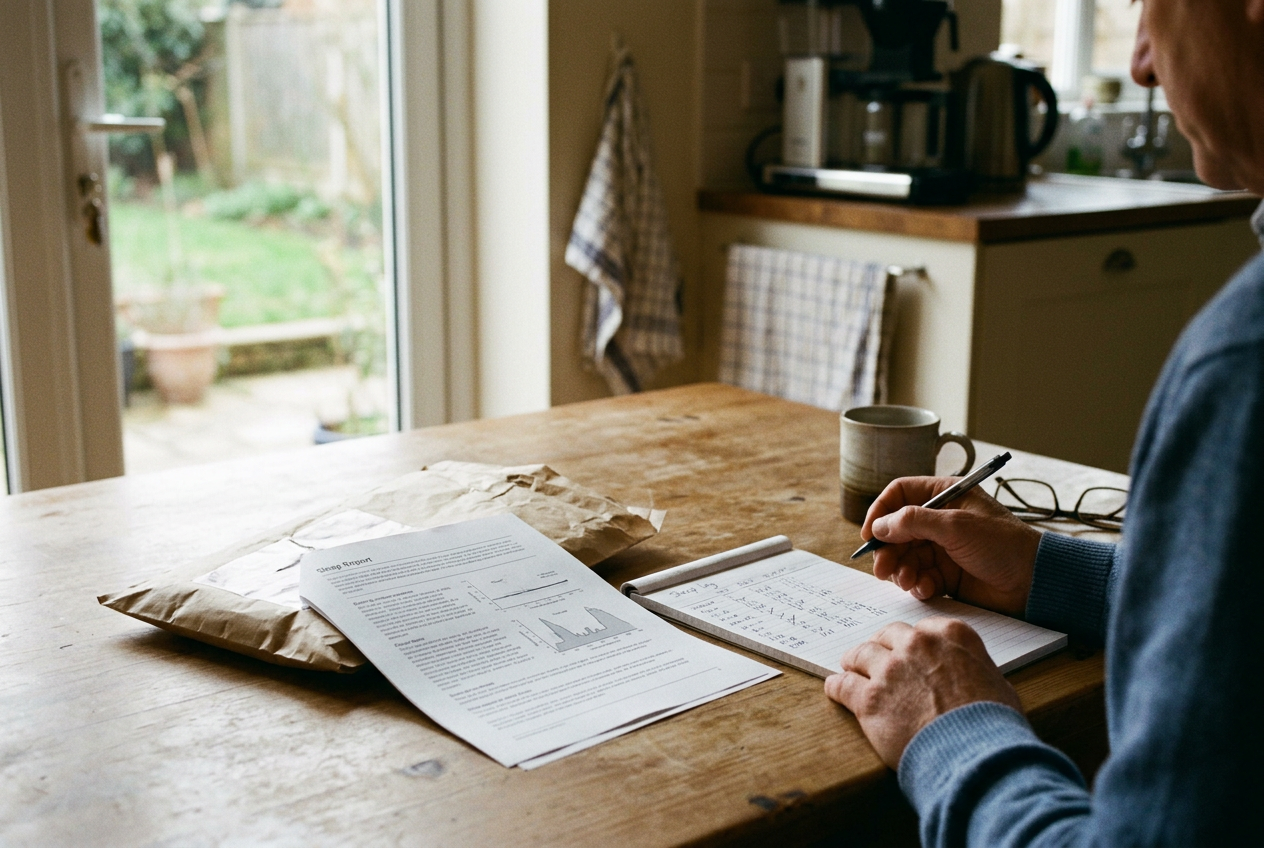
The difference became clearer when he held his printed sleep report beside the paper sleep log that came with the kit. The report showed 7 hours and 12 minutes of recording. On the log, Andre had noted that he was awake for about 86 minutes after putting on the sensors, then woke several more times because the finger probe felt loose.
The report still used the full stretch of usable recording to calculate how often his breathing changed. Andre read the number as reassurance. His specialist read it as incomplete information.
This distinction matters because a home test can be very useful when obstructive sleep apnea is strongly suspected in an adult without certain complicating health conditions, but it does not reproduce everything that happens during an overnight lab study.
What the home kit sees
Sleep apnea is a condition in which breathing repeatedly stops or becomes shallow during sleep. In obstructive sleep apnea, the more common form, the upper airway narrows or closes even though the body is still trying to breathe.
A home sleep apnea test is designed mainly to look for that breathing pattern. The setup varies, but common devices measure airflow at the nose and breathing effort through a band around the chest or abdomen. A finger sensor usually records blood oxygen and pulse.
Those signals can show that air stopped moving while the chest kept working, or that oxygen fell around the same time breathing became restricted. Some devices collect body position, movement or sound as added context.
Most home tests do not record the brain waves used to tell whether someone is awake, lightly asleep or in rapid eye movement sleep, also called REM sleep. REM is a normal sleep stage when dreaming is common and some people have more breathing disruptions.
Without brain-wave measurements, the device may treat much of the recording period as possible sleep. Newer home systems may estimate sleep through movement or other signals, but an estimate is not the same as measuring sleep stages directly.
That difference changes the arithmetic. A home report often gives a respiratory event index, meaning the number of breathing disruptions divided by the hours of valid monitoring. A lab report commonly gives an apnea-hypopnea index, which divides pauses and partial reductions in breathing by hours of measured sleep.
If a person records for 7 hours but sleeps for much less, spreading the breathing events across the longer period can make the home number look lower. It is like calculating a delivery rate using the entire time the truck was running, including a long stretch parked at the depot, rather than the time spent on the route.
Andre’s paper sleep log could not correct the test by itself. It did show his specialist that the 7 hours and 12 minutes on the printed report were not 7 hours and 12 minutes of sleep.
What changes in a sleep lab
An overnight laboratory sleep study is called polysomnography. The word means that several body signals are recorded together while a person sleeps.
Sensors on the scalp measure brain activity, which lets the sleep team identify sleep and its stages. Sensors near the eyes track eye movements, while small patches around the chin and legs record muscle activity. Other equipment records airflow, breathing effort, oxygen level and heart rhythm.
The combination matters. A drop in airflow means more when the report can show that the person was asleep, what sleep stage they were in and whether the chest was still trying to pull in air. Leg sensors may also capture repeated movements that fragment sleep, although the meaning of any finding depends on the full clinical picture.
A technician monitors the signals during the study. If a sensor comes loose, the technician can replace it, which is one practical advantage over a home test where no one is present to notice that a finger probe has shifted or an airflow tube has moved.
The lab is less natural. The room is unfamiliar, sensors can be bothersome and some people sleep differently on their first night there. A lab study can still produce useful information because it identifies which parts of the night were true sleep, even when sleep is shorter or more broken than usual.
For Andre, that was the missing measurement. His later lab report separated time in bed from time asleep and showed that his breathing disruptions clustered during measured sleep, including a period of REM sleep. His specialist interpreted the pattern as obstructive sleep apnea after considering the study with his symptoms and health history.
That does not mean every person who starts with a home test will need a lab study. It means the tests answer overlapping but unequal questions.
What can interfere with either result
At home, the person applies the equipment after receiving instructions. A belt may loosen. The airflow sensor may move during sleep. A finger probe can lose contact, leaving a gap in the oxygen record, and nasal congestion may affect the airflow signal collected at the nose.
Andre’s printed report showed a gap in the finger-sensor data. He remembered adjusting the probe, but he had been too sleepy to know how long it was out of place. The note in his paper sleep log gave the specialist context that the device could not supply.
A person’s schedule also matters. Someone who works early mornings, nights or changing shifts may test during a sleep period that is shorter than usual. Insomnia can leave a person awake for long stretches that a basic home device cannot distinguish from sleep, which may lower the calculated event rate.
Lab studies have their own sources of uncertainty. Someone may sleep less because of the unfamiliar setting, spend less time on their back or never reach much REM sleep, even though breathing problems can become more apparent in those circumstances. The extra sensors improve measurement, but one night cannot represent every night of a person’s life.
Clinicians interpret either study alongside symptoms, medical history and the quality of the recorded signals. A number printed on the report is not the whole result.
Why a follow-up study happens
A home study may lead to a lab study when the recording is technically inadequate, the result is negative or uncertain despite continuing concern, or the clinician needs information the home equipment does not collect.
Some people are sent to the lab first. That can happen when a clinician is concerned about breathing problems beyond straightforward obstructive sleep apnea, including central sleep apnea, in which the brain does not consistently send the signal to breathe. Significant heart or lung disease, muscle weakness affecting breathing, opioid use and severe insomnia can also change which test is considered appropriate.
The choice is not a ranking of serious and less serious patients. It reflects the clinical question and how many signals are needed to answer it.
Andre’s home test had been easier to fit around his route and cost less under his insurance plan. The lab study required more planning, but it resolved the mismatch between his symptoms, his paper sleep log and a home result that had looked low at first glance.
This article cannot tell you which test fits your medical history, whether a result explains your symptoms or whether another study is warranted. The ordering clinician or a sleep specialist can interpret those details; an insurer can explain coverage and authorization requirements, which vary by plan.
Questions people ask
Can a home sleep test diagnose sleep apnea?
A clinician can use a technically adequate home test to diagnose obstructive sleep apnea in some adults whose symptoms and medical history make that condition likely. The test is narrower than a lab study, and it is generally not designed to evaluate every cause of poor sleep or daytime sleepiness.
Is a lab sleep study always more accurate?
A lab study records sleep stages and more body signals, while a technician can correct loose sensors during the night. Even so, the unfamiliar setting can change how someone sleeps, and a single lab night may not capture every usual pattern. The clinician interprets the recording in context rather than treating it as a perfect snapshot.
Why would
I need a lab study after a normal home result?
A home result can look normal when the person slept less than the device assumed, when too much signal was lost or when breathing disruptions happened in a sleep stage the night barely captured. In Andre’s case, the paper sleep log and finger-sensor gap made the low number less reassuring to his specialist.
Will insurance cover both tests?
Coverage depends on the health plan, medical history and reason for the follow-up study. Some plans require authorization or documentation that the home result was negative, uncertain or technically inadequate. Andre checked with the insurer before the lab visit and kept the approval message with both printed sleep reports.
One story a day
The story of the day, in your inbox
One health journey each morning — no advice, no alarm, just company for the road.