She Was Blamed for 63 Pounds. A Pituitary Tumor Was Driving It
For 26 months, rapid weight gain and hypertension were treated as evidence of poor discipline. A notebook helped show the pattern that led to Cushing's disease and a benign pituitary tumor.
 Theo MarshNarrator, The Long Road
August 21, 2026 · 7 min read
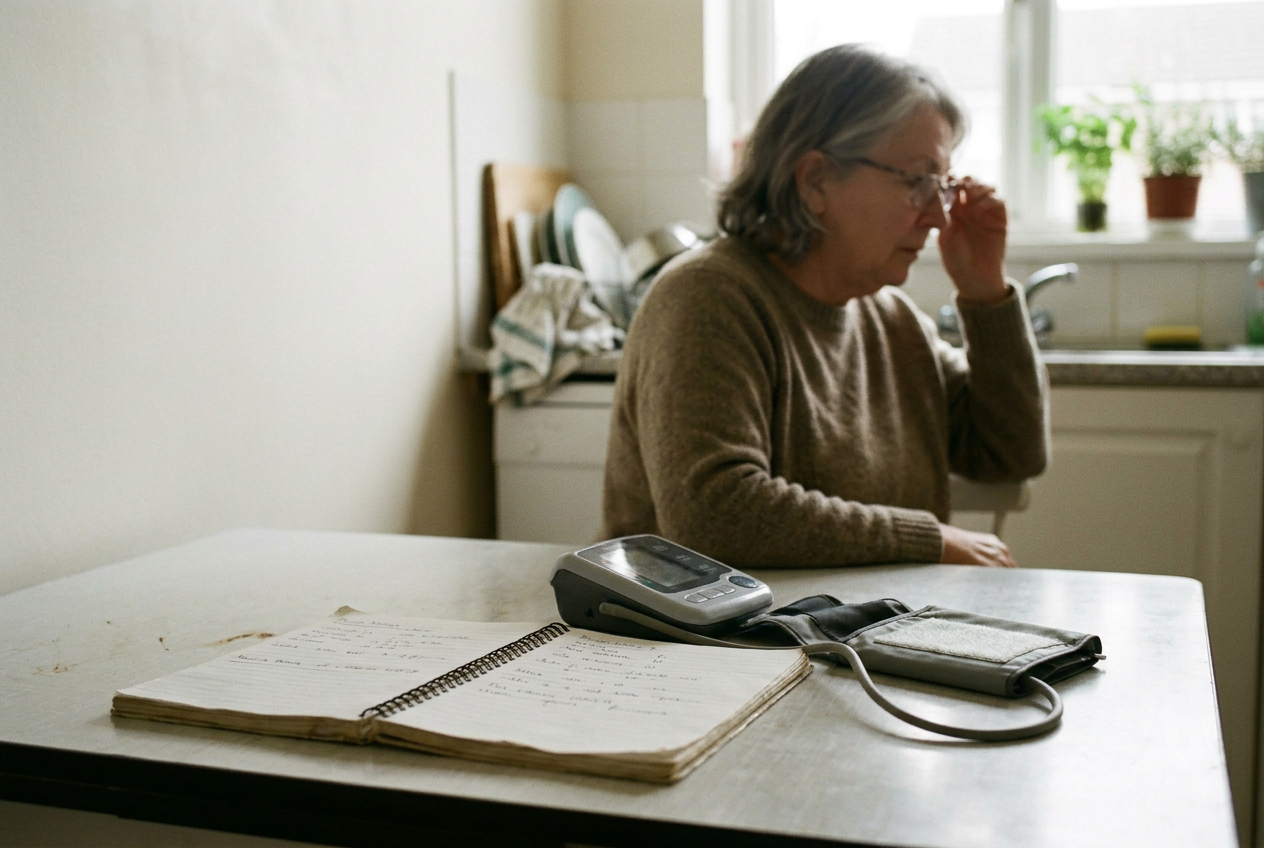
In June 2018, Mara began a notebook because the numbers no longer made sense.
Mara is a composite, assembled from published first-person accounts. At the start of that summer, she weighed 148 pounds. Six weeks later, the scale read 159. She wrote both numbers in the notebook, along with what she had eaten and whether she had walked after work.
She expected to find an explanation in the pages.
There was no dramatic change to find. She still packed lunch most weekdays. Her job remained sedentary, as it had been for years, but she had not stopped moving. The weight continued to arrive at a rate that felt separate from her choices, while her face grew rounder and her rings became difficult to remove.
At her first primary care appointment, the discussion centered on calories. The doctor ordered routine bloodwork, which did not explain the gain, and recommended lifestyle changes. Mara copied that phrase into the notebook beneath her weight.
It became the artifact of the next 26 months: dates, blood pressure readings, photographs she had taken on her phone, and short accounts of what doctors believed she was failing to do.
The first twelve months
By January 2019, Mara had gained 37 pounds. Her blood pressure, previously unremarkable, was now repeatedly high at appointments. She had headaches and a dense fatigue that sleep did not correct, but those symptoms entered the chart as separate complaints while her weight remained the organizing fact.
One clinician asked whether she understood portion sizes. Another suggested that stress could account for the blood pressure and eating habits. Mara did not remember being asked how quickly the weight had appeared until she opened the notebook and supplied the dates herself.
The record was exact about her weight. It was less curious about its speed.
She responded by becoming more exact. She measured food for eight weeks and kept receipts from the grocery store. She walked despite the weakness developing in her thighs, which she noticed first when getting up from the couch. When her weight increased another nine pounds, she brought the notebook back to primary care.
The next round of laboratory work included thyroid testing. The result was within the laboratory's reference range. That closed one possibility, but in the appointment that followed, it was treated more broadly, as reassurance that there was no medical explanation.
Mara left with another discussion of diet.
Her face changed faster than the rest of her appearance. By that spring, people who had not seen her for a few months paused before speaking, then asked whether she was tired. Acne returned for the first time since her twenties. Bruises appeared after minor contact and lasted long enough that she began entering them in the notebook too.
The notebook was becoming evidence, although nobody had agreed to examine it as a whole.
The most consequential dismissal came after a visit for worsening hypertension. Mara had gained 63 pounds in 14 months, and she brought photographs showing the change in her face. The clinician reviewed the blood pressure readings, adjusted the plan for managing them, and returned to weight loss. In Mara's account, the photographs remained on her phone.
She understood that weight can raise blood pressure. What remained unanswered was why both had changed so rapidly, alongside muscle weakness and bruising, in someone whose previous weight had been stable for years. The question was not complicated. It was repeatedly displaced.
A pattern gets a name
In early 2020, a different primary care doctor read farther back in the chart. The appointment had been scheduled for swelling near Mara's collarbone and another high blood pressure reading, but the doctor asked about the first change rather than the latest one.
Mara opened the notebook.
The doctor moved through the dates: 11 pounds in six weeks, 37 pounds by seven months, 63 pounds by 14 months. She looked at the photographs, asked when the bruising began, and tested Mara's leg strength. The discussion did not produce a diagnosis. It produced a referral to an endocrinologist, which was the first acknowledgment that the pattern might belong to one process.
The specialist appointment took three months to obtain. By then, Mara had developed wide stretch marks across her abdomen and was taking medication for hypertension. She had cut back her work hours because concentrating through the afternoon had become difficult, a financial concession that made the earlier instructions to exercise more feel especially detached from what her body could do.
The endocrinologist discussed excess cortisol. Cortisol has essential roles in the body, but sustained exposure to too much can affect weight distribution, blood pressure, skin, muscles, mood, and blood sugar. Many of those effects are common on their own. Together, and unfolding over a defined period, they pointed the specialist toward Cushing syndrome, the term for the physical consequences of excess cortisol from any cause.
Testing did not rest on one blood draw. Over the next two months, Mara collected urine for a full day, provided late-night saliva samples, and completed a suppression test intended to show how her cortisol system responded. Some results were clearer than others. Repetition mattered because cortisol varies, and Mara's first borderline result briefly revived the possibility that stress and weight were distorting the picture.
The later results showed persistent excess cortisol. Another blood test suggested that the signal was being driven by adrenocorticotropic hormone, or ACTH, which directs the adrenal glands to produce cortisol. The specialist then ordered imaging of the pituitary gland.
In August 2020, a portal report described a small lesion.
Mara read the line at home with the notebook beside the computer. The lesion was measured in millimeters, far smaller than anything that seemed capable of changing the shape of her face or the force needed to stand from a chair. Its position, laboratory findings, and her clinical pattern supported Cushing's disease, the form of Cushing syndrome caused by an ACTH-producing pituitary tumor.
The tumor was believed to be benign. Benign described its cancer status, not the reach of its effects.
Surgery did not restore the missing months
A pituitary surgeon recommended removing the tumor through the nasal passage. Insurance authorization and surgical scheduling added another two months. Mara kept notes on those calls in the same notebook, but the administrative entries were brief. The result she had spent two years trying to obtain was already there: the weight gain had not been a confession about discipline.
Surgery took place in October 2020. Pathology identified a benign pituitary adenoma with ACTH activity, matching the biochemical evidence that had accumulated before the operation. Her cortisol dropped afterward, which her team interpreted as evidence that the source had been removed.
Recovery was not a reverse film of the illness. Mara needed hormone replacement while her body's cortisol system adjusted under specialist supervision. Her blood pressure improved over the following months, and the swelling in her face began to recede, but weakness lasted longer. Weight came off unevenly.
Some stretch marks faded without disappearing.
There was no appointment at which a clinician calculated what earlier recognition would have changed. The notebook offered a rough measure: 26 months from the first unexplained gain to surgery, with most of that interval spent treating the visible consequence as the cause.
At a follow-up in spring 2021, Mara brought the notebook even though the specialist could see the test results in the chart. She had added postoperative laboratory dates and one blood pressure reading from home. The specialist reviewed them, then discussed continued monitoring because pituitary Cushing's disease can recur after an apparent remission.
Mara went back to working her usual hours later that year. The ordinary tasks returned before confidence did. She still hesitated before appointments, expecting a discussion of willpower to replace whatever question she had brought into the room.
The notebook remained in a kitchen drawer. On a weekday after work, she opened it to record another follow-up result, closed it, and started dinner.
Questions people ask
Why was
Cushing's disease mistaken for lifestyle-related weight gain?
Mara's early symptoms were common when viewed separately, and clinicians repeatedly used her weight to explain the hypertension and fatigue. The diagnostic direction changed only after one doctor considered the speed of the gain alongside facial swelling, bruising, muscle weakness, and the dated photographs in her notebook.
What was the difference between
Cushing syndrome and Cushing's disease in her case?
Her specialist used Cushing syndrome for the effects of prolonged excess cortisol, which can have different causes. Cushing's disease was the more specific diagnosis after testing indicated excess ACTH and imaging found a pituitary lesion that surgery later confirmed was a benign ACTH-producing adenoma.
Did finding the pituitary tumor settle everything immediately?
No. The imaging result had to be interpreted with hormone tests and her symptom history, and surgery was followed by specialist-managed hormone replacement and continued laboratory monitoring. Her blood pressure and facial swelling improved over months, while weakness and distrust of medical appointments lasted longer.
What part of her record changed the course of the story?
No single notebook entry proved the cause. Its value was chronological: it showed 63 pounds gained in 14 months and placed the bruising, weakness, facial change, and hypertension on the same timeline. At her later visits, Mara still carried it, then returned it to the kitchen drawer.
One story a day
The story of the day, in your inbox
One health journey each morning — no advice, no alarm, just company for the road.